
Clay living room ideas start with a problem most inspiration photos hide. Clay looks warm and grounded in every picture, then turns muddy or loud in real rooms.
The color itself is not the issue. Clay fails for two specific, fixable reasons, and both have names. This page is built around fixing them.
Failure one is mud. Several warm colors at the same depth, with nothing cool beside them, blur into one brown mass.
Failure two is loud. Clay at full saturation beside warm yellow or orange wood starts to shout. The room reads fast food, not fireside.
Two rules prevent both. Match the dust, and step the depth. Everything below is those two rules applied.
You will also get the paint ladder with LRV, the pairing table, three worked schemes, a care schedule, and the name collision warning that saves you from buying the wrong Studio Clay.
What Clay Color Actually Is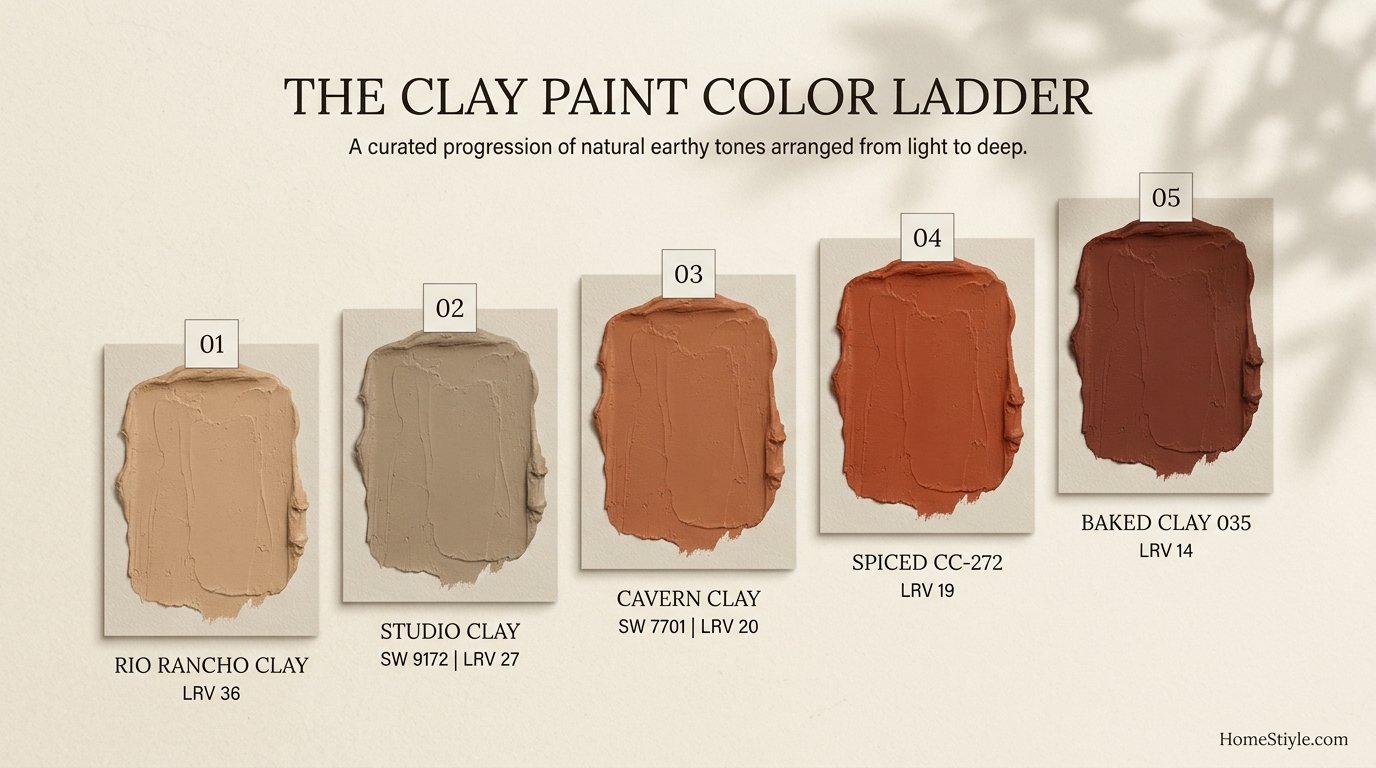
Clay is the fired earth family. It runs from pale clay pink through mid terracotta to deep brick brown.
Terracotta means baked earth in Italian, and it is clay’s most famous shade. Clay is the wider family, paler and quieter at one end.
What makes a color read as clay is dustiness. Gray and brown are mixed in, so the color looks dug up, not manufactured.
A bright orange is not clay. A brick red with no brown in it is not quite clay either.
The family matters because every member pairs the same way. Learn the rule once and the whole ladder behaves.
Keep this test in mind while shopping. If a swatch looks clean and bright, it will fight your clay. If it looks slightly grayed, it belongs.
The Two Rules
Rule One: Match the Dust
Pair every clay with a partner that has the same amount of gray in it. The full pairing guidance at Quiet Minimal builds its whole system on this one idea.
A dusty terracotta beside a bright kelly green looks like a party decoration. The same terracotta beside dusty sage looks like a hillside.
Green is the natural partner because it sits across the color wheel from red orange. It makes the warm color look warmer and cleaner by contrast.
Use the pairing list as your shopping rule. Light terracotta pairs with sage, and rust pairs with olive.
Ocher pairs with deep forest green, the pairing explored in the forest green living room ideas. Pale clay pink pairs with a soft gray green.
That soft gray green is exactly the tone in the eucalyptus green living room ideas. Chocolate brown pairs with moss, as in the moss green living room ideas.
Then pick a lead. A working balance is roughly two parts warm to one part green, placed where it shows from the doorway.
A fifty fifty split looks undecided. Let one temperature clearly lead.
Rule Two: Step the Depth
Never repeat one clay depth on every surface. Ladder the room instead: pale, mid, and deep clay in different places.
Walls usually take the mid or pale step. Cushions and pottery carry the deep step in small, cheap doses.
The ladder is also your budget tool. Pale on the big surfaces, deep only where a small item can carry it.
The Clay Paint Ladder
These five paints cover the ladder. Third party LRV figures for the Benjamin Moore colors are marked approximate on their source pages, so treat them as guidance and let the wall swatch decide.
|
Paint |
Brand and number |
LRV |
Undertone |
Best use |
|---|---|---|---|---|
|
Rio Rancho Clay |
Benjamin Moore 111 |
about 36 |
reddish orange, brown |
lightest walls, north rooms |
|
Studio Clay |
Sherwin Williams 9172 |
27 |
orange yellow greige |
quiet warm neutral walls |
|
Cavern Clay |
Sherwin Williams 7701 |
20 |
red, coppery |
accent walls, mid depth |
|
Spiced |
Benjamin Moore CC-272 |
about 19 |
brown, reddish orange |
brown leaning clay walls |
|
Baked Clay |
Benjamin Moore 035 |
about 14 |
terracotta, muted brown |
deep walls, drench, features |
Cavern Clay SW 7701 is the anchor of the ladder. Sherwin Williams named it Color of the Year in 2019, and it never really left.
The color card data at RenoDiary lists its RGB as 172, 107, 83, with a red undertone. It also names Benjamin Moore Baked Terra Cotta 1202 and Audubon Russet HC-51 as close alternatives.
At LRV 20, Cavern Clay is a committed mid tone. The project guidance at ArtFasad frames it as mid toned enough to avoid reading dark in most spaces.
Studio Clay SW 9172 is the quiet end of the family. It is a warm greige taupe clay that Sherwin Williams included in its 2025 Colormix Forecast.
Rio Rancho Clay 111 is the ladder’s light step. Its warmth suits north facing rooms, where cooler clay can go flat and gray.
Baked Clay 035 is the deep step. Use it where depth is the point: a fireplace wall, built ins, or a full drench in a bright room.
Spiced CC-272 leans brown. It is the pick for readers who love the family but find terracotta too orange.
The Name Collision Warning
Two major brands sell a paint called Studio Clay, and they are different colors. The full comparison at The Paint Color Project documents the collision in detail.
The Sherwin Williams version, SW 9172, has an LRV of 27 and leans orange yellow. The Benjamin Moore version has an LRV of 28 and leans red orange, slightly more saturated.
A third Studio Clay exists at Behr, a warm off white. Ordering by name alone can land you in the wrong family entirely.
Baked Clay has the same problem across paint lines. The rule that protects you is simple: buy by brand plus number, never by name.
Clay Walls: Accent, Full Room, or Drench
One accent wall behind the sofa is the low risk classic. The color becomes a backdrop, not the first thing seen from the door.
A full room suits pale to mid clay in decent light. Keep the sofa and rug lighter than the walls so the ladder still steps.
Color drenching paints walls, trim, and ceiling in one shade. The shade guide at LetsMakeCozy notes it removes the hard lines where surfaces meet.
In a small, well lit room, drenching can make the space feel larger and more cohesive, not smaller. That surprises most people.
Deep clay drenching is a deliberate mood choice. Reserve it for bright rooms or rooms used mainly in the evening.
For low light rooms, including the basement conversions in the basement living room ideas, stay at the pale end or use deep clay on one wall only.
Clay by Light
Light changes clay four times a day. Morning light turns a clay wall amber gold.
Afternoon sun deepens the same wall toward brick. The ArtFasad project notes describe the room effectively changing character between morning and evening.
North light cools and dims everything. Studio Clay reads cooler and more greige there, while Rio Rancho Clay keeps its warmth.
South light warms and browns clay. A mid clay can read a full step deeper by midday.
Warm bulbs flatter clay but can push it orange. Test your final two swatches under your actual lamps, not the store’s lighting.
Deep clay, LRV under 20, needs layered light. Add lamps at two heights or the color sits flat and brown by evening.
The Test First Protocol
Do not start with paint. Clay is cheap to test and expensive to repaint.
Step 1: Cushions and one pot. Two cushions and one clay pot are the documented starting point. Live with them for a week.
Step 2: Swatch two walls. Paint large swatches on two different walls, because light hits them differently. Read them morning and evening.
Step 3: Commit in order. Textiles, then one wall, then the full room or drench. Each step is reversible until the last one.
Step 4: Keep the numbers. Photograph the swatches beside the paint can label. The brand plus number is your reorder insurance.
Furniture in a Clay Living Room
Keep the sofa a contrast, not a match. Warm linen, cream, oatmeal, or soft sage all sit well against clay walls.
A clay sofa on clay walls flattens the room unless the depths step well apart. If the sofa is clay, keep the walls pale or neutral.
The reverse scheme works beautifully. A clay or terracotta sofa on neutral walls is the statement route, and it forgives daily life.
Decor guidance collected at LetsMakeCozy notes that clay toned upholstery hides crumbs, pet hair, and spills better than pale linen. Mid tones do the hiding.
A gray sofa can work if the gray leans warm. Bridge it with clay cushions and a wood or brass middle tone.
A leather sofa is clay’s oldest partner. Cognac and tan leathers sit one step deeper than most clay walls, which is the ladder working for free.
Fiber, Wood, and Metal: The Materials Layer
Clay is a materials color before it is a paint color. The rooms that get it right lean on things from the ground.
Lay a flat jute or seagrass rug under the seating. It sets the ground plane and keeps clay grounded, not floating.
Rattan and woven pieces add fiber texture without color risk. A rattan mirror or woven wall plates fill a wall in clay’s own language.
Choose raw and mid tone woods first. Very orange stained wood fights clay at the same visual frequency.
Aged brass warms clay, and matte black gives the eye a rest. Project guidance pairs clay with raw wood, aged brass, and matte black, not chrome or glossy white.
Linen curtains in cream or oatmeal finish the layer. Texture beats pattern everywhere in this palette.
Terracotta Tile and Clay Plaster: The Permanent Layer
Terracotta floor tiles are the Mediterranean original. They add texture, warmth, and an authentic material link to the color story.
Sealed terracotta tile is rated for 50 to 100 years of life in project guidance. The catch is the reseal cycle, every 3 to 5 years.
That cycle is the real commitment. If resealing sounds unlikely, choose porcelain that imitates terracotta and keep the look without the schedule.
Clay plaster is an earthen wall finish with a soft, matte, varied surface. It suits feature walls and low wear zones best.
Plaster costs more than paint and needs specialist application. Most living rooms should master paint first, then consider plaster for one wall.
Limewash is the middle path. It gives a cloudy, clay like variation with a simpler application than true clay plaster.
Clay Schemes by Style
Boho Clay
Boho is clay’s home style. Layer fiber, pottery, rattan, and plants over a clay and cream base, and keep the dustiness rule so layers do not muddy.
Mediterranean Clay
Run terracotta tile or a deep clay wall with white plaster tones, dark wood, and black metal. This is the oldest version of the palette.
Minimalist Clay
Use one clay wall or one clay piece, quiet textiles, and fiber texture. This is Studio Clay territory: greige clay, low saturation, no pattern pile up.
Desert Modern Clay
Pair Cavern Clay depth with pale wood, stone, and sculptural shapes. Keep accessories few and large.
The Green Led Room
Flip the ratio. Let a dusty green lead and use clay as the warm accent, the approach in the pistachio green living room ideas.
The same dustiness rule applies in reverse. Clay cushions on a sage sofa follow the identical law as the reverse pairing.
Pottery, Plants, and the Small Layer
Group pottery in three depths of clay: pale, mid, and deep. Odd numbers and mixed heights keep the group natural.
Put a green plant in at least one pot. The green is the living version of the pairing rule, working for free.
Unglazed terracotta breathes and stains. Use saucers, and keep unglazed pots off pale rugs and wood without a barrier.
Rotate the small layer seasonally. Fall deepens to rust and chocolate, winter adds cream knits and brass, spring lightens to pale clay pink and sage.
The base palette never changes. Only the small, cheap layer moves.
Renter Friendly and Budget Clay
Renters can run the whole palette in textiles only. Clay cushions, throws, a clay toned rug, pottery, and one plant in a terracotta pot.
Nothing needs permission, and everything leaves with you. Add a large clay toned art print for wall scale without paint.
Budget order matters. Spend first on the rug and cushions, which set dustiness and depth for the whole room.
Paint is the cheap big move when you are allowed it. One gallon covers a test accent wall in most living rooms.
Save the sofa for last. It is the most expensive way to add clay and the hardest to reverse.
Care Schedule for Clay Rooms
Natural materials reward small, regular care. None of it is hard, but the schedule is real.
|
Item |
Care |
Cycle |
|---|---|---|
|
Terracotta floor tile |
reseal with a penetrating sealer |
every 3 to 5 years |
|
Unglazed pots |
empty, dry, and check for water marks |
each season |
|
Jute and seagrass rugs |
vacuum without a beater bar, blot spills |
monthly check |
|
Linen upholstery |
rotate cushions, spot clean promptly |
monthly |
|
Matte clay walls |
dust, touch up scuffs from the kept pot |
as needed |
|
Limewash or plaster |
no scrubbing, specialist repair for chips |
as needed |
Keep a labeled touch up pot of your wall color. Matte clay shows scuffs like any matte paint, and a five minute touch up keeps it invisible.
The Pairing Table
Print this beside the ladder when you shop. Every row obeys both rules at once.
|
Clay tone |
Partner of equal dust |
Lead suggestion |
|---|---|---|
|
Light terracotta |
sage |
clay leads, sage accents |
|
Rust |
olive |
clay leads, olive upholstery |
|
Ocher |
deep forest green |
green can lead here |
|
Pale clay pink |
eucalyptus gray green |
either can lead |
|
Chocolate brown |
moss |
green accents, clay depth |
Notice what is not on the table. There is no bright green, no warm yellow, and no icy white anywhere.
Those three are the spell breakers. If a candidate partner is brighter or cleaner than your clay, it fails the dust test.
Three Worked Schemes
Scheme One: The Accent Wall Classic
Paint the sofa wall in Cavern Clay. Keep the other walls a warm cream and the sofa oatmeal linen.
Add sage cushions, a jute rug, and one deep clay pot with a green plant. The ladder reads pale walls, mid wall, deep accents.
Scheme Two: The Quiet Drench
Drench a small, bright room in Studio Clay, trim and ceiling included. Layer cream textiles and one rust throw as the only deep note.
The room feels wrapped, not painted. This is the scheme for readers who want clay’s warmth at greige volume.
Scheme Three: The Green Led Room
Paint the walls a dusty sage or eucalyptus tone. Bring clay in through the sofa or armchairs, cushions, and pottery.
The ratio flips, the rule does not. Clay still needs its depths stepped against the green: pale rug, mid sofa, deep cushions.
Choosing Your Application
|
Application |
Cost |
Reversibility |
Best for |
|---|---|---|---|
|
Textiles only |
lowest |
total |
renters, testers |
|
One accent wall |
low |
one repaint |
most living rooms |
|
Full room, pale clay |
medium |
one repaint |
north and small rooms |
|
Color drench, mid clay |
medium |
one repaint |
bright, small rooms |
|
Tile or plaster |
highest |
renovation |
owners, long term homes |
Read the table bottom up if you are unsure. Every household can start at the top row this weekend.
Move down only when the row above has lived well for a season. Clay rewards patience because its failures are slow to notice and fast to annoy.
Clay in Open Plan Spaces
Clay is a strong continuity color. Run it on the living walls and repeat one clay note in the kitchen zone.
Good repeats: stool seats, a tile tone, pottery on the counter. Bad repeats: restarting the whole palette at full strength.
Keep the shared floor one material where possible. The floor is the ground both zones stand on.
Clay With Kids and Pets
Mid clay is the forgiving zone. It hides the daily evidence better than pale fabrics and pale walls alike.
Choose washable cushion covers and keep the deep step in pottery and throws, the replaceable layer. Save pale clay for walls, where hands rarely linger.
For pet hair, match the rug to the mid step. Hair shows least against the middle of the ladder.
Trim, Doors, and Ceilings in Clay Rooms
Trim decides whether clay feels soft or sharp. A warm white trim keeps the edges gentle and the walls in charge.
A bright, blue white trim fights clay the same way chrome does. It is a cool note at full brightness, and it wins arguments it should lose.
In a drench, paint trim and ceiling the same clay. The room loses its outline and gains calm.
In an accent wall scheme, a clay painted door on the accent wall disappears into it beautifully. The same door in white becomes a bright rectangle competing with the art.
Ceilings can take one step paler than the walls. That half step keeps the lid light while the family resemblance holds.
Skirting and crown in the wall color make low ceilings feel taller. The eye stops finding the edges to measure against.
Mistakes to Avoid
- Repeating one depth everywhere. Walls, sofa, and cushions in the same clay flatten the room. Step the ladder.
- Pairing by warmth instead of dustiness. A bright green beside dusty clay breaks the spell instantly.
- Warm yellow at full saturation. Beside clay it reads fast food, per project guidance. Use ocher sparingly instead.
- Buying paint by name. Two Studio Clays and multiple Baked Clays exist. Brand plus number, always.
- Skipping the swatch. Third party LRV data is approximate. The wall, in your light, is the only final source.
- Matching the sofa to the wall. Contrast is the whole point. The wall is the sun, the sofa is the stone ledge catching light.
The Swatch Clinic: Reading Clay Like a Professional
Paint two large swatches, at least a foot square each. Small chips lie about clay because depth reads stronger at scale.
Place one swatch in your brightest corner and one in your dimmest. The same paint will read as two ladder steps apart.
Judge the swatch at three times: morning, midday, and under lamps. Clay that passes all three readings is your color.
Check the undertone against white paper. Hold plain white beside the swatch and the red, orange, or brown lean shows itself.
Compare the final two candidates side by side for one full day. The one that stays calm at every light wins, not the one that dazzles at noon.
Write the brand, name, and number on the wall behind a picture. Future you, holding a touch up brush, will be grateful.
Art and the Styled Layer
Art on clay walls should carry one cool note. A landscape with sage or slate in it does the pairing rule’s work on the wall itself.
Avoid art that is all warm tones on a clay wall. The frame becomes the only separation, and the mud creeps in at picture scale.
Black frames are the safest choice on mid and deep clay. They add the rest note without another color decision.
Style shelves with the three depths rule: one pale, one mid, one deep clay object per shelf. The ladder works at every scale, including a bookcase.
Books count as color. A row of cream and sage spines is a styling tool, not clutter, in a clay room.
Leave one surface empty in every styled view. Clay rooms read calm when the eye gets one quiet place to land.
How to Start Your Clay Living Room
Decide the lead temperature first. Warm clay led, or green led with clay accents, and commit to roughly two to one.
Pick your ladder step for the walls by light. Pale for north and small rooms, mid for most, deep only with light to spare.
Test in textiles, then swatch, then paint one wall. That order keeps every early step cheap and reversible.
If you are planning the whole home scheme, the wider ideas at HomeStiyle sit inside the same color cluster. Clay and the green family are designed to interlock.
Frequently Asked Questions
What color is clay in a living room?
Clay is the fired earth family: muted red orange browns between pale clay pink and deep terracotta. It reads warm and dusty, never bright orange, because gray and brown mute it.
What is the difference between clay and terracotta?
Terracotta is clay’s most famous shade, the mid to deep baked earth tone. Clay is the wider family, running paler (clay pink, greige clay) and quieter than classic terracotta.
What colors go with clay in a living room?
Pair clay with equally dusty partners: sage, olive, eucalyptus gray green, cream, oatmeal, chocolate, and matte black. The rule is matching dustiness, not just matching warmth.
Why does my clay room look muddy?
Mud happens when several warm colors share one depth with no cool partner. Add an equally dusty green or a slate or black rest note, and step the depths apart.
What green goes with terracotta and clay?
Match the green to the clay’s depth: light terracotta with sage, rust with olive, ocher with deep forest, pale clay pink with eucalyptus gray green, chocolate with moss.
What is the best clay paint color for a living room?
The ladder anchors are Sherwin Williams Cavern Clay SW 7701 (LRV 20) mid depth, Benjamin Moore Baked Clay 035 (about LRV 14) deep, Rio Rancho Clay 111 (about LRV 36) light, and SW Studio Clay for the quiet greige end.
Is Cavern Clay still in style in 2026?
Yes as a classic rather than a trend. Named Sherwin Williams Color of the Year in 2019, it stayed in designer use because the tone is elemental. Style it with current textures and it reads timeless.
How dark is Cavern Clay SW 7701?
Its LRV is 20, a committed mid tone. It reads warm and present without closing most rooms down. In dim north light test it first, and consider it for one wall there.
What is the LRV ladder for clay paints?
From light to deep: Rio Rancho Clay about 36 (approximate), Studio Clay 27 to 28 by brand, Cavern Clay 20, Spiced CC-272 about 19, Baked Clay 035 about 14. Higher LRV means lighter. Always swatch, because third party LRV figures are approximate.
Which clay paint works in a north facing living room?
North light cools and dims, so choose warmer, lighter clay or use deep clay on one wall only. Studio Clay reads cooler and greige in north light, while Rio Rancho Clay keeps warmth.
Can clay walls work in a small living room?
Yes. Use pale clay or a full color drench, where walls, trim, and ceiling share one shade and the hard lines disappear. LetsMakeCozy notes drenching can make a lit room feel larger and more cohesive.
Should I paint one wall or the whole room clay?
One wall behind the sofa is the low risk classic. The whole room suits pale to mid clay in decent light. Deep clay whole room works in large, bright rooms or as a deliberate drench.
What color sofa goes with clay walls?
Keep the sofa a contrast, not a match: warm linen, cream, oatmeal, soft sage, or leather. A clay sofa on clay walls flattens the room unless depths step well apart.
Can I use a clay or terracotta sofa with neutral walls?
Yes, it is the statement route. Clay upholstery also hides everyday wear better than pale linen, per decor guidance. Support it with clay cushions or pottery so it does not float alone.
What rug works in a clay living room?
A flat jute or seagrass rug sets the ground plane and keeps clay grounded. Patterned rugs should pull one clay tone plus a green or black note, not several warm tones at one depth.
What curtains go with clay walls?
Use linen in cream, oatmeal, or a dusty sage. Avoid warm yellow curtains at full saturation beside clay. Texture beats pattern in this palette.
What wood tones suit clay?
Raw and mid tone woods first, then aged and darker woods for depth. Very orange stained wood fights clay at the same frequency. Test a sample board against the swatch.
What metal finishes pair with clay?
Aged brass warms it and matte black rests the eye. Chrome and glossy white read cold and sharp against clay, per project guidance. Mixed brass and black is the safest pair.
How do I test clay before committing?
Start with cushions and one clay pot, the lowest risk test. Then swatch paint on two walls and read it morning and evening. Only then commit to a wall or a sofa.
What is clay plaster, and is it right for a living room?
Clay plaster is an earthen wall finish with a soft, matte, slightly varied surface. It suits feature walls and low wear zones. It costs more than paint and needs specialist application, so most rooms use paint first.
Are terracotta floor tiles practical in a living room?
Very, when sealed. Guidance rates sealed terracotta tile at 50 to 100 years of life with resealing every 3 to 5 years. The reseal cycle is the real maintenance commitment.
How do I style terracotta pots and pottery indoors?
Group three depths of clay (pale, mid, deep) in odd numbers, and put a green plant in at least one. The green is the living version of the pairing rule.
Does clay work with a gray sofa?
Yes, if the gray is warm leaning. Add clay cushions and a wood or brass bridge so the cool gray and warm clay meet through a middle tone. Blue gray is the harder partner.
Does clay work in a minimalist living room?
Well. Use one clay wall or one clay piece, quiet textiles, and fiber texture. Minimalist clay is Studio Clay territory: greige clay, low saturation, no pattern pile up.
What about a boho clay living room?
Boho is clay’s home style: layered fiber, pottery, rattan, and plants over a clay and cream base. Keep the dustiness rule so layering does not turn muddy.
Can renters do a clay living room?
Yes, textiles only: clay cushions, throws, a clay toned rug, pottery, and a plant in a terracotta pot. The whole palette leaves with you, and no paint permission is needed.
How much clay is too much?
Watch the ratio. A working balance is about two parts warm neutral and clay to one part green or cool rest notes. A fifty fifty warm green split looks undecided.
What colors should I avoid with clay?
Avoid warm yellow at full saturation beside clay, bright kelly green against dusty clay, and orange stained wood. Each fights clay at its own frequency or breaks the dustiness match.
Is there more than one paint called Studio Clay or Baked Clay?
Yes, and it is a buying trap. Sherwin Williams and Benjamin Moore both sell a Studio Clay (LRVs 27 and 28, different leans), and Baked Clay exists in more than one line. Always buy by brand plus number.
What is the difference between SW Studio Clay and BM Studio Clay?
Sherwin Williams Studio Clay SW 9172 (LRV 27) leans orange yellow greige taupe. Benjamin Moore’s Studio Clay (LRV 28) leans red orange and slightly more saturated. They are different colors sharing a name.
What paint pairs with Cavern Clay?
Cross brand alternatives and partners include Benjamin Moore Baked Terra Cotta 1202 and Audubon Russet HC-51 as near relations, plus warm gray, deep brown, muted denim, and greens as partners. Trim in a warm white keeps it soft.
Can clay work in an open plan living and kitchen?
Yes, clay is a strong continuity color. Run clay on the living walls and repeat one clay note (stools, pottery, a tile splashback tone) in the kitchen. Repeat, do not restart, the palette.
How do I warm up a gray living room with clay?
Add clay in three touches: cushions, a throw, and pottery or art with clay tones. If the gray is warm, stop there. If it still reads cold, a clay accent wall finishes the shift.
What lighting suits a clay living room?
Warm bulbs flatter clay but can push it orange, so test paint under your actual bulbs. Layer ambient plus lamp light; deep clay (LRV under 20) needs more light to avoid flat brown.
Does clay hide dirt and wear?
On upholstery, yes, mid clay tones hide crumbs, pet hair, and spills better than pale fabrics, per decor guidance. On walls, matte clay shows scuffs like any matte paint, so keep a touch up pot.
What is the cheapest way to add clay?
Two cushions and one clay pot are the documented starting point, then a throw. Paint for one accent wall is the next step; a single gallon covers a test wall in most rooms.
Can I mix clay with other earthy colors like ocher and rust?
Yes, inside the ladder: use ocher sparingly as the lightest warm note, rust as a mid bridge, and clay as the base. The failure is all three at one depth and saturation.
What style eras does clay suit?
Mediterranean, Southwestern, desert modern, boho, and warm minimalism all run on clay. It also warms transitional rooms with classic furniture. It fights cool glam (chrome, icy white, jewel brights).
How do I do seasonal decor in a clay living room?
Rotate the small layer only: fall adds rust and chocolate depth, winter adds cream knits and brass, spring lightens to pale clay pink and sage. The base palette never changes.
Is clay a good choice for resale and staging?
In textiles and one wall, yes: warm rooms photograph invitingly. Whole room deep clay is a taste commitment; stage with the cushion and pottery version and let buyers see the option, not the obligation.
What is the first step to plan a clay living room?
Decide the lead temperature (warm clay led or green led), pick your ladder step for the walls by light, then test in textiles. Paint is step three, not step one.
Where can I check a clay color before buying?
Use the brand’s own color page for the number and LRV, and cross check a color card source for undertones. Third party LRV figures marked approximate should be treated as guidance, and the wall swatch decides.
Conclusion
Clay living room ideas succeed or fail on two rules. Match the dust, so every clay tone sits beside a partner with the same gray in it.
Step the depth, so pale, mid, and deep clay each take a different surface. Follow both and the room stays warm without ever turning muddy or loud.
Start where the rules are cheapest: cushions, one pot, and a swatch. When the test week feels like a hillside at golden hour, paint the wall and let the ladder do the rest.
Keep the brand plus number discipline for every can you buy, and keep a labeled touch up pot in the cupboard. Those two small habits protect the scheme for years.
Then live in it through one full season before judging. Clay is a slow color, and its reward is a room that feels settled, warm, and quietly sure of itself in every light the year brings.

1 thought on “Clay Living Room Ideas: Match the Dust, Step the Depth for a Warm Room That Never Turns Muddy”