
Moss green bathroom ideas fail in a way no paint card warns about. The color goes on warm and earthy at noon, then the evening bulbs turn it muddy brown or, under cooler light, cold and clinical.
The problem is rarely the paint. Moss is a muted warm green with a gray component, and a bathroom is the one room where light is almost entirely artificial, so the bulbs you choose are effectively part of the color.
This guide works in the order the room does. Set the light temperature first, commit by surface from paint to tile, place moss against its family with named paints and real data, and keep the partners warm.
What Moss Green Is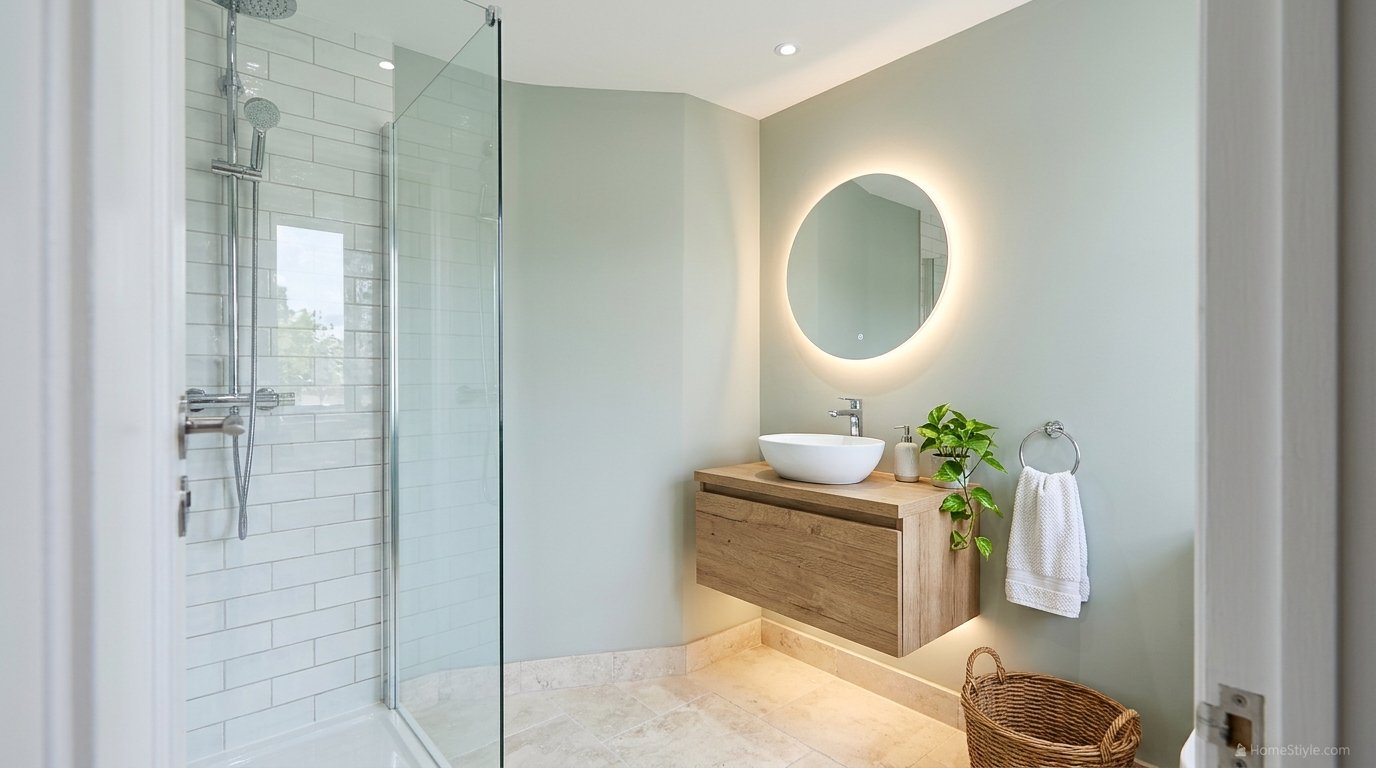
Moss green is a muted, yellow leaning green softened by gray. It sits in the warm middle of the green family: earthier than sage, cleaner than olive, and far lighter in spirit than forest.
That warmth is its bathroom advantage. Bathrooms are small, often windowless, and lit at a mirror, conditions that punish cool colors and reward a green with a warm base.
The color research behind this guide, including the full family map and paint ladder, lives at our moss green living room ideas. This page applies that research to the one room with water, steam, and bulbs.
Think of moss as a temperature first. The same can of paint becomes three colors under three bulb temperatures, which is why light comes before surfaces here.
The Family Map: Moss Against Its Siblings
Sage is grayer and cooler, with a silvery cast. In a north facing or windowless bathroom, sage can read cold and flat where moss stays warm, because moss carries the yellow base sage lacks.
Olive is browner and more golden. It suits rustic and Mediterranean rooms, but in a small bathroom its brown weight can crowd the space where moss’s gray keeps the air in the room.
Forest is deeper and bluer, the drama color. Our sibling page at our forest green bathroom ideas owns that register; moss is the choice when you want the green mood at a warmer, lighter temperature.
Eucalyptus is bluer and silvery, the spa catalog color. It photographs beautifully and lives cool, which makes it the riskiest sibling under warm bulbs and the least forgiving in dim rooms.
Moss is the warm muted middle of that map. It is the sibling most likely to survive your bathroom’s actual light, which is a more useful virtue than being the most striking on a card.
Temperature First: The Bulb Rule
A dark green design guide, The Fact Relay, states the rule this niche keeps burying. Aim for bulbs between 2700K and 3000K in a green bathroom, because that band keeps the color warm and true.
Above 3500K, the same guide warns, green turns clinical. Cool white light strips the yellow warmth out of moss and leaves the gray, which reads as cold, flat, and slightly institutional at the mirror.
Below 2500K, the failure flips. Very warm bulbs push moss’s yellow base too far, and the color collapses toward muddy brown, the single most common complaint about green bathrooms.
Treat the band as a specification, not a preference. Check the Kelvin rating on every bulb in the room, including the vanity fixture and any backlit mirror, because one cool bulb in a warm room still shows.
Testing Samples at the Mirror
Bathroom color judgment happens in one place: standing at the sink, under the vanity light, morning and evening. Test there, not in a hallway and not under shop lighting.
The same guide’s second rule is to test samples on multiple walls. Vanity bulbs pull yellow or blue undertones out of the same paint depending on their temperature, and different walls catch that light at different angles.
Paint large swatches, at least a foot square, on the wall beside the mirror and on the wall opposite it. Live with them through three days of routines before committing to any surface.
Change the bulbs before the paint if a sample disappoints. A moss that fails under 4000K bulbs often succeeds under 2700K bulbs, and bulbs are the cheapest variable in the room.
The Bulb Temperature Table
|
Bulb temperature |
What moss does |
Verdict |
|---|---|---|
|
Under 2500K |
Collapses toward muddy brown |
Too warm |
|
2700K to 3000K |
Warm, earthy, true to the card |
The target band |
|
3500K to 4000K |
Gray takes over, reads flat |
Risky |
|
Above 4000K |
Cold and clinical at the mirror |
Avoid |
Brightness matters alongside temperature. Dark walls absorb light, so a moss bathroom wants generous lumens at the vanity, delivered by sconces or a lit mirror rather than one ceiling bulb.
Commit by Surface: The Ladder
Color commitment in a bathroom comes in four surfaces, each with its own cost of regret. Paint is a weekend, a vanity is a purchase, tile is a renovation, and a floor is a renovation you walk on.
Work the ladder in order unless a renovation is already planned. Most readers should prove the color in paint first, because moss under your bulbs is the experiment everything else depends on.
The ladder also splits the budget honestly. A reader with one weekend and a reader with a contractor can both use this guide, at different rungs, without pretending their projects are the same.
Surface One: Paint, With Drenching
Paint is the cheapest full test of moss. One color across the walls transforms the room for the price of a gallon and a weekend, and it reverses in an afternoon if the light verdict goes against it.
Color drenching is the advanced move, defined well in the Find A Way by JWP green bathroom guide. Instead of green walls with a white ceiling, white trim, and a white vanity, the same green carries across walls, trim, and cabinetry.
Drenching suits small bathrooms especially. One continuous color removes the visual seams that chop a small room into pieces, and the room reads as an intentional envelope rather than a box with a colored wall.
Paint the ceiling too on the full version. A roundup pro tip in the competitor set makes the case: carrying the color overhead creates the cocooning, spa like envelope that makes the room feel designed rather than decorated.
Surface Two: The Vanity Dial
The vanity is the middle commitment, one furniture piece that can carry the color while the walls stay neutral, or step aside and let the walls carry it. The design guidance splits the choice cleanly.
Against green walls, choose a natural oak vanity. Oak brings warmth without introducing another strong color, and the guide tunes the tone to the room: medium or smoked oak in darker bathrooms, pale oak or ash in smaller ones.
Against neutral walls, paint the vanity in the same green family. A moss vanity under a natural stone countertop becomes the room’s single color statement, reversible later with one repaint.
Never run both at full strength by accident. Green walls and a green vanity work only as a deliberate drench with the counter and metals planned; as an accident, the room doubles its color and loses its contrast.
Surface Three: Tile, Placed With Restraint
Tile is the renovation commitment, and zellige style tile is its current vehicle. The design guidance describes the handmade look: subtle color variation, irregular edges, and a gentle reflection that makes the wall feel crafted rather than printed.
Place it with restraint. Inside the shower, behind the vanity, or on one architectural wall are the guide’s placements; tiled everywhere, the variation that charms in one zone becomes noise in four.
A real project, the Houzz Magazine bathroom project, proves the move at small scale: a 62 square foot bathroom where moss green zellige lines the lower shower walls beneath a lighter mosaic, with unlacquered brass throughout and warm marble at the vanity.
Moss tile pairs with warm stone by the guide’s own recipe. Moss green tile, honed limestone, oak, and aged brass is the combination it names first, because the stone’s warmth balances the green while the wood and metal hold the register.
Sealing: The Rule Porous Tile Carries

Handmade zellige is glazed terracotta, and terracotta is porous. The product data for a moss green zellige, the Fired Earth Medina moss zellige listing at Hyperion Tiles, states the requirement plainly: seal before and after grouting.
That one UK retailer’s page (a non-US source, used here for material facts, not prices) also fixes the tile’s honest specs: handmade in Fez, 10 by 10 centimeters, suited to interior walls and light traffic floors.
Encaustic and cement floors carry the same discipline, and guidance at the Opple House green bathroom guide states it for floors: seal moss encaustic floor tiles before regular use to protect them from moisture and stains, with a timber vanity as the pairing.
Skipping sealer is the expensive mistake in this category. An unsealed porous tile in a shower drinks soap and hard water from week one, and no cleaning regime fully reverses the staining.
Surface Four: The Floor
A moss floor grounds a bright room. Patterned encaustic or small format tile underfoot lets the walls stay pale and warm, reversing the usual arrangement for readers who fear dark walls.
Matching grout keeps the floor calm. The small room guidance in the competitor set uses matched grout on green floor tile to create a nearly continuous surface, which reads larger than a contrast grid.
Floors take the most moisture and the most regret. Choose rated porcelain or properly sealed cement tile, and treat the floor as the last surface to commit, after paint has proven the color in your light.
The Commitment Ladder Table
|
Surface |
Cost of regret |
Best first room |
Reversible? |
|---|---|---|---|
|
Paint, drenched |
One weekend |
Powder room |
Yes, fully |
|
Vanity, painted or oak |
One purchase |
Guest bath |
Mostly |
|
Tile, one zone |
Renovation days |
Shower or vanity wall |
No |
|
Floor, sealed tile |
Renovation plus sealing |
Primary bath |
No |
Read the ladder against your light verdict. No rung should be bought before the paint test has shown what moss does under your bulbs, because every surface amplifies the same color.
Named Moss Paints, With Data
Names without numbers are marketing. The paints below carry LRV values from reference data computed from manufacturer color data, labelled as computed strands, because a bathroom decision needs to know how much light a color returns.
Wethersfield Moss HC-110 sits at LRV 25.92 in that computed data. It is the ladder’s anchor: a true moss depth that holds full walls in a dim bathroom without collapsing to black.
Forest Moss 2146-20 computes to LRV 27.51 with a hue angle of 59 degrees. The hue is the proof of the warm base: at 59 degrees the color leans yellow, which is exactly the warmth the bulb rule protects.
Rural Green SW 6418 computes to LRV 22.62. It is the deepest of the three anchors, best kept to drenched powder rooms and vanity paint where its weight reads as luxury rather than gloom.
Tree Moss 508 is the pale outlier at LRV near 47 from a color data listing. It serves readers who want the moss family at a lighter register, in brighter rooms or on a single wall.
The Named Paint Table
|
Paint |
LRV strand |
Best bathroom use |
|---|---|---|
|
Wethersfield Moss HC-110 |
25.92, computed |
Full walls, dim rooms |
|
Forest Moss 2146-20 |
27.51, computed |
Walls plus warm proof hue |
|
Rural Green SW 6418 |
22.62, computed |
Powder room drench, vanity |
|
Tree Moss 508 |
Near 47, listing |
Pale register, bright rooms |
Forest neighbors like Pewter Green and Essex Green are not mosses. They are deeper, bluer colors sold nearby on the card rack, and a trends aggregator even calls moss cooler than olive; the hue data disagrees, and this guide follows the data.
Roundup paint codes deserve one caution. Clare’s Current Mood appears in the competitor set under two different codes in different entries, so verify any roundup’s paint code against the manufacturer before ordering.
Partners: Warm Stone, Wood, and Metals
The combination table in the design guidance gives moss a one line recipe: travertine, oak, and bronze, earthy and cozy. Every partner in this guide extends that line, and the register never changes.
Honed limestone is the guide’s favorite stone. It lists limestone for the vanity countertop, the shower ledge, a windowsill, a small stool, a tray, and even the floor, because its warm variation flatters moss everywhere it lands.
Wood follows the oak rule from the vanity section, with walnut as the darker register. Pale oak lightens, medium oak balances, smoked oak and walnut deepen, and orange toned wood is the one wood problem to bridge or avoid.
Metals stay warm without exception. Aged or brushed brass and dark bronze are the register; the guide warns to use brass selectively, at the faucet and mirror frame rather than everywhere, because restraint is what makes it read expensive.
The Chrome Exclusion, Stated Plainly
One competitor’s moss entry gives the rule in negative form, and it deserves headline status. Avoid cool toned grays and chrome finishes alongside moss green, because they create visual discord that undermines the warm, organic mood.
The mechanism is temperature. Chrome reflects blue white light, which fights moss’s yellow base at exactly the points your eye touches most: faucet, handles, mirror frame, and shower fittings.
If the room already has chrome, the budget order is bulbs first, then the faucet and mirror frame, then the rest. Two warm touchpoints change the room’s register before a full refit is needed.
Black fixtures are the one cool adjacent exception. Matte black reads as a neutral outline rather than a temperature, and the competitor set uses it against moss successfully, though brass remains the warmer and safer default.
Cream Over Stark White
White choice is a color decision here. Stark blue white beside a yellow based green makes the green look dirty and the white look icy, a muddle the living room research on this cluster documented first.
Choose warm whites and creams for ceilings outside a drench, towels, and any painted woodwork. The white recedes, the moss stays clean, and the room’s whole register holds at warm.
The same rule governs sanitaryware you cannot change. Most tubs and toilets are bright white; surrounding them with warm textiles, wood, and brass keeps that fixed white from setting the room’s temperature.
Small and Windowless Bathrooms
Small changes the strategy, not the color: guidance at the Panyl small dark green bathroom guide frames the small dark bathroom as a balance problem, saturated surfaces weighed against thoughtful lighting, reflective finishes, efficient storage, and lighter materials.
Moss is better suited to dim rooms than its siblings because its base is warm. Sage and eucalyptus go colder as light falls; moss goes earthier, which is the direction a small room can afford.
Keep an LRV floor for full walls. In a windowless room, full wall moss should stay in the low twenties LRV or above from the named ladder; the deepest strands belong on the vanity or in a powder room drench.
Storage protects the color’s effect. A drenched room with bottles across every surface reads as clutter in one color; drawers, a mirrored cabinet, and one oak shelf keep the envelope calm.
Moisture Discipline: The Bathroom-Only Layer
Bathrooms add a constraint no other room has. Steam, splashes, and daily humidity test every finish, so the color decision includes the paint’s formulation, not just its name.
Choose a bathroom rated paint with moisture and mildew resistance, in satin or a quality eggshell. Flat matte looks beautiful in photographs and marks, blooms, and tires fastest in a working shower room.
Ventilation is part of the color system. An extractor that actually clears steam protects paint, grout, and sealer alike, and a color chosen for a damp room will fail in a wet one no matter its LRV.
Sealed tile, rated paint, and working ventilation are the three legs. The guides that skip this layer are writing about living rooms with tubs; a bathroom guide has to include it.
Three Budgets, Three Versions
The weekend version is paint only: moss walls, warm bulbs swapped in, cream towels, one oak or woven accessory. It proves the color in your light for the smallest possible money, and it is the right first project for almost everyone.
The mid version adds the vanity: painted moss under stone, or oak against the new walls, with brass touchpoints at faucet and mirror. The room gains its anchor piece and its warm metal register in one step.
The full version commits tile: a zellige shower or vanity wall, sealed properly, with the drench carried across walls, trim, and ceiling. This is the magazine room, and it should only be built on a color already proven in the same space.
Costs stay strands, not quotes. Paint runs to tens of dollars per gallon in quality lines, handmade tile prices by the square foot vary widely by maker, and any round number for your room belongs to your measurements, not to a guide.
Mistakes That Ruin Moss Bathrooms
Cool bulbs are mistake one, and the cheapest to fix. A 4000K vanity bar can make a perfect moss look like a hospital corridor, and owners repaint colors that were never wrong.
The white ceiling default is mistake two. In a small bathroom it caps the room, cuts the envelope, and makes the green walls look like an accent that lost its nerve; drench it or warm it.
Glossy finishes are mistake three in this register. The competitor set warns that gloss fights the moody, hand finished atmosphere; matte, honed, and eggshell surfaces catch light unevenly, which is the texture moss wants.
Vivid red accents are mistake four. Moss with a true red turns festive in the wrong way, so the palette mutes red into terracotta, rust, or blush.
The wider palette lives at our color shelf on the HomeStiyle home page, beside room guides like our moss green bedroom ideas and our forest green living room ideas.
Two-Tone Zellige: The Project Lesson
The Connecticut project holds one more lesson worth stealing. Its shower runs two zellige colors together: moss green squares lining the lower half and a lighter beige mosaic above, both handmade, both unlacquered brass beside them.
The move solves the dark shower problem. A full height dark shower drinks the room’s light, but a dark lower half grounds the space while the pale upper half returns light at face height, where the room is actually used.
It also halves the tile budget’s risk. The expensive handmade color covers the zone the eye rests on, and a simpler light mosaic carries the rest, so the statement survives a smaller order.
Copy the principle even without zellige. Any dark lower register with a lighter upper register, wainscot style, gives a small bathroom the grounding of moss without paying the full darkness price.
Lighting Placement, Not Just Temperature
Temperature sets the color’s character, and placement sets its fairness. Light that comes only from above carves shadows into faces and makes any deep wall color read harsher than it is.
Put light at face height beside the mirror. Sconces flanking the mirror, or a lit mirror with an even field, flatter skin, show the paint honestly, and make a dark room feel deliberate rather than dim.
Add dimming if the budget allows one luxury. A drenched moss room at full brightness is a showroom; the same room dimmed in the evening is the cocoon the drench promised, and the difference is a switch, not a renovation.
Judge the room twice a day during the sample stage. Morning routines and evening baths are different lighting events, and a moss that passes both has genuinely earned its surfaces.
Accents: Terracotta, One Cool Guest, Muted Red
With partners set warm, accents have three safe lanes. Terracotta, rust, and camel extend the earth register; a woven basket, a clay vessel, or a camel towel stack warms the room without adding a new color family.
One cool guest is allowed on a short leash. A single navy element, a bath mat or a framed print, gives the warm room its contrast note; two cool elements start a second palette and the room’s temperature splits.
Red stays muted or absent. Blush and muted coral are the safe forms, close enough to warm the palette and far enough from true red to avoid the festive pairing that vivid red and green always threaten.
Plants finish the accent layer honestly. A humidity loving fern in a moss bathroom is the biophilic idea made literal: the color’s source, alive in the room, thriving on the steam every other finish has to survive.
Frequently Asked Questions
1. What color is moss green in a bathroom?
Moss green is a muted warm green with a gray component. It leans yellow rather than blue, sits between sage and forest in depth, and in a bathroom its warmth is what keeps small, dim rooms from reading cold.
2. What bulb temperature suits a moss green bathroom?
Aim for 2700K to 3000K. A dark green design guide gives that band for green bathrooms, warm enough to keep the yellow base alive and cool enough to keep the color clean at the mirror.
3. Why does my green bathroom paint look muddy brown?
Very warm bulbs push the yellow base too far. Below 2500K the color collapses toward muddy brown, so swap the bulbs before blaming the paint, because the cheapest variable in the room is usually the guilty one.
4. Why does my green bathroom look cold and clinical?
Cool light strips the warmth out. Above 3500K the gray component takes over and moss reads flat and clinical, especially at the vanity, so check the Kelvin rating on every bulb, including lit mirrors.
5. Can you color drench a small bathroom?
Yes, and small rooms suit drenching best. One continuous color across walls, trim, and cabinetry removes the visual seams that chop a small room into pieces, so it reads as an intentional envelope instead of a colored box.
6. Should the ceiling be painted in a color drenched bathroom?
On the full version, yes. Carrying the color overhead completes the cocooning envelope that makes the room feel designed, and a white ceiling left by default caps the room and weakens the whole effect.
7. Does chrome go with moss green?
No, chrome fights moss. Its blue white reflection clashes with the color’s warm yellow base at the faucet, handles, and mirror frame, and the competitor guidance warns against it directly, so choose aged brass or bronze instead.
8. What metals suit a moss green bathroom?
Warm metals only: aged brass and dark bronze. Used selectively at the faucet and mirror frame rather than everywhere, warm metals hold the room’s register, while matte black is the one acceptable neutral outline.
9. What is the difference between moss green and sage green?
Sage is grayer and cooler, moss is warmer. Sage carries a silvery cast that can read cold in dim bathrooms, while moss’s yellow base keeps it earthy, which is why moss survives north facing and windowless rooms better.
10. What is the difference between moss green and forest green?
Forest is deeper and bluer, moss is lighter and warmer. Forest brings drama at a cooler temperature, while moss delivers the green mood with an earthy warmth that suits small and daily use bathrooms.
11. Is moss green good for a small bathroom?
Yes, with light discipline. Keep full wall moss at LRV in the low twenties or above, deliver generous warm light at the vanity, and use storage and reflective finishes to balance the saturated color.
12. Is moss green safe in a windowless bathroom?
Yes, moss is the safest sibling there. With no daylight to correct it, the warm base keeps the color earthy under bulbs in the 2700K to 3000K band, where cooler greens turn flat or icy.
13. Which moss green paints have an LRV in the twenties?
Three anchors sit in the twenties. Computed reference data puts Wethersfield Moss HC-110 at 25.92, Forest Moss 2146-20 at 27.51, and Rural Green SW 6418 at 22.62, all labelled strands from manufacturer color data.
14. What LRV is Wethersfield Moss?
LRV 25.92, from computed reference data. That places Wethersfield Moss HC-110 in the safe band for full walls in dim bathrooms, deep enough for the mood and light enough to keep its warmth visible.
15. What is the warmest moss green paint?
Forest Moss 2146-20 is the proof of warmth. Its computed hue angle of 59 degrees leans yellow, which is the warm base itself measured, and its LRV of 27.51 is the lightest of the deep anchors.
16. Should I paint the vanity moss or use oak?
Decide by which surface already carries color. Against green walls, an oak vanity adds warmth without another strong color; against neutral walls, a painted moss vanity under stone becomes the single statement.
17. Where should moss green tile go in a bathroom?
One zone, placed with restraint. Inside the shower, behind the vanity, or on one architectural wall are the placements design guidance gives, because handmade variation charms in one zone and becomes noise in four.
18. Do zellige tiles need sealing in a bathroom?
Yes, before and after grouting. Zellige is glazed terracotta and porous, and the product data for a moss green zellige states the sealing requirement plainly, so treat sealer as part of the tile’s price.
19. Do encaustic floor tiles need sealing?
Yes, sealing is part of the installation. Encaustic and cement tiles are porous, and design guidance instructs sealing moss encaustic floors before regular use to protect them from moisture and stains.
20. What sheen should bathroom paint be?
Satin, or a quality eggshell in bathroom rated paint. Moisture and mildew resistant formulations survive steam and splashes, while flat matte marks and tires fastest in a working shower room.
21. What colors go with moss green in a bathroom?
Warm stone, wood, and metals. Honed limestone or travertine, oak in a tone matched to the room’s light, aged brass or bronze, and cream rather than stark white form the recipe the design guidance repeats.
22. Does white go with moss green in a bathroom?
Yes, if the white is warm. Cream and warm white support moss, while stark blue white makes the green look dirty and itself look icy, so warm every white you can choose, from towels to trim.
23. What wood suits a moss green bathroom?
Oak first, walnut for depth. Pale oak lightens small rooms, medium oak balances, smoked oak and walnut deepen darker rooms, and orange toned wood is the one problem pairing to bridge with textiles.
24. Can moss green work in a north facing bathroom?
Yes, conditionally, and moss beats sage there. Its warm base holds up in cool daylight, provided full walls stay in the low twenties LRV or above and the evening bulbs sit inside the warm band.
25. How do I test moss paint before committing?
At the mirror, on multiple walls, for three days. Paint foot square swatches beside and opposite the mirror, live with them through morning and evening routines, and change bulbs before changing paint if a sample disappoints.
26. What grout color suits moss green tile?
Matching grout for calm, contrast for pattern. Matched grout makes green tile read as one continuous surface, which suits small rooms, while a contrasting grout draws a grid that should only be chosen on purpose.
27. Can I do a moss green bathroom with paint only?
Yes, paint is the recommended first version. Moss walls, warm bulbs, cream textiles, and one wood accessory prove the color in your light for the smallest money, and the project reverses in an afternoon.
28. How much does a moss green bathroom refresh cost?
Costs are strands, not quotes. Quality paint runs to tens of dollars per gallon and handmade tile varies widely per square foot, so any honest total comes from your room’s measurements and your chosen rung.
29. Is moss green a trend or timeless?
Moss is closer to timeless than trendy. Muted earthy greens predate the current cycle and the warm muted register ages slowly, though the zellige and drenching treatments around it are the fashionable layer.
30. What style of bathroom suits moss green best?
Collected, organic, and warm modern rooms suit it best. Cottage, midcentury, and modern organic bathrooms all hold moss comfortably, because the color asks for natural materials and restrained combinations rather than a period costume.
31. Can moss green work in a modern bathroom?
Yes, through material discipline. Floating oak vanities, frameless glass, and one zellige wall keep moss contemporary, and the color’s gray component is what lets it sit inside modern restraint without turning rustic.
32. Can moss green work in a midcentury bathroom?
Yes, midcentury is a natural home. Vertical stacked moss tile with a walnut vanity is a documented arrangement in the competitor set, and the era’s warm woods and brass are moss’s own partner register.
33. What towel colors suit a moss green bathroom?
Warm whites and natural linen tones. Cream towels keep the register warm, woven textures add the soft layer, and a single terracotta or rust accent can warm the stack without turning the room busy.
34. Do plants suit a moss green bathroom?
Yes, humidity friendly plants complete the idea. The biophilic layer is literal in a moss room, and ferns and other moisture loving plants thrive in bathroom humidity while echoing the color’s source.
35. How do I keep a dark bathroom from feeling smaller?
Balance it with light, reflection, and storage. Generous warm vanity light, a large mirror, lighter stone or textiles, and closed storage keep a saturated small room reading intentional rather than shrunken.
36. Can renters do a moss green bathroom?
Yes, through the paint only rung. Paint, warm bulbs, and textiles change nothing structural and reverse fully, which makes the lowest rung of the commitment ladder the renter’s version of the whole guide.
37. What is color drenching in a bathroom?
One color carried across every painted surface. Walls, trim, and cabinetry share the paint instead of the default green walls with white everything else, which removes contrast seams and wraps the room in a single envelope.
38. Should trim match the walls in a moss bathroom?
Yes, in a drenched room trim follows the walls. Same color trim is what makes drenching read as one envelope, and a white trim line would redraw every seam the method exists to remove.
39. What mirror suits a moss green bathroom?
A warm framed mirror suits it best. Aged brass or wood frames hold the register, backlit mirrors must be checked for a warm temperature rating, and a large mirror earns its place by returning light to the room.
40. How bright should bathroom lighting be with dark green walls?
Generous at the vanity, in the warm band. Dark walls absorb light, so deliver strong lumens at face height from sconces or a lit mirror in the 2700K to 3000K band rather than relying on one ceiling bulb.
41. Does moss green show water spots and soap scum?
Less than pale glossy tile, with a finish caveat. Matte and honed surfaces in deep colors can show dried mineral marks, so sealed tile, regular squeegee habits in the shower, and satin paint make the upkeep ordinary.
42. Can moss green pair with black fixtures?
Yes, as the neutral exception. Matte black reads as an outline rather than a temperature, and the competitor set uses it against moss successfully, though aged brass remains the warmer and safer default choice.
Conclusion
Moss green bathroom ideas succeed when the room is handled in the order it actually works. Light first, because moss green is a temperature before it is a color and your bulbs are part of the paint.
Surfaces second, climbed as a ladder: paint proven in your own light, then the vanity, then tile sealed and placed with restraint. Partners third, warm without exception: limestone, oak, brass, and cream.
Start with the weekend version and the bulb swap, and let the room cast its vote. The color shelf behind this guide, from living rooms to bedrooms, is gathered at the HomeStiyle home page.
