
Clay bathroom ideas begin with a sorting problem of their own. One word names a muted color, a family of plasters, and the oldest tile material on earth, and a bathroom treats each one differently.
The color is the easy half. Clay is terracotta with the volume down, a warm register you can paint on any wall in the room.
The substances are the serious half. Water sorts them into zones, and the most fashionable plaster in this search is forbidden from showers by its own maker.
Three disciplines keep the room honest. Define the register first, zone the substances second, and pair warm on warm third, with the sealing law running underneath all of it.
The Register: Terracotta With the Volume Down
A true clay color is muted and earthy, with more brown than orange in its base. It reads like the inside of the pot, where terracotta reads like the fired outside.
That muting is the whole point. Clay gives a small bathroom warmth without noise, saturation low enough to cover four walls without shouting.
|
Register |
Clay |
Terracotta |
|---|---|---|
|
Base note |
Brown first |
Orange and rust first |
|
Saturation |
Muted, dusty |
Rich, sun baked |
|
Best walls |
All four, cocoon style |
Accent first, all four with care |
|
Metals |
Black anchor, copper, brass |
Same ranking, more contrast |
|
Failure mode |
Reads flat or muddy |
Reads orange |
Sort any card with the white paper test. Hold the paint card against plain white paper and name the skew you see: red, orange, or brown.
Run the test in daylight, not under shop lighting. Store lights warm every card toward the orange skew, which is how a brown clay gets misread at the shelf.
Brown skews behave best in bathrooms. Red skews go cottage and dusty pink in warm light, and orange skews are the ones owners describe as surprisingly loud once four walls are up.
The full register research lives in our clay bedroom ideas. The bathroom version adds water, steam, and tile to the same color science.
The Zone Map: Water Assigns Every Substance
Every bathroom has four zones, and materials care about zones more than about style. Designing by zone first is what separates a durable clay bathroom from a six month regret.
The four zones of any bathroom:
- Wet: inside the shower and around the tub, where water lands daily and directly.
- Splash: behind sinks and beside tubs, where water arrives often but briefly.
- Humid: walls that only meet steam, the majority of most bathrooms.
- Dry: powder room walls and any surface water never reaches.
Paint in a bathroom rated formula covers all four zones happily, which is why the color is the flexible half of this topic. The substances are not flexible, and each has a maker or importer saying so.
|
Substance |
Wet |
Splash |
Humid |
Dry |
|---|---|---|---|---|
|
Bathroom paint in clay tones |
Yes |
Yes |
Yes |
Yes |
|
Roman clay plaster |
No |
Sealed, cautiously |
Yes |
Yes |
|
Terracotta and Saltillo tile |
Sealed only |
Yes, sealed |
Yes |
Yes |
|
Glazed zellige and ceramic |
Yes |
Yes |
Yes |
Yes |
|
Tadelakt lime plaster |
Yes |
Yes |
Yes |
Yes |
|
Porcelain terracotta look |
Yes |
Yes |
Yes |
Yes |
Roman Clay: The Maker’s Own Limits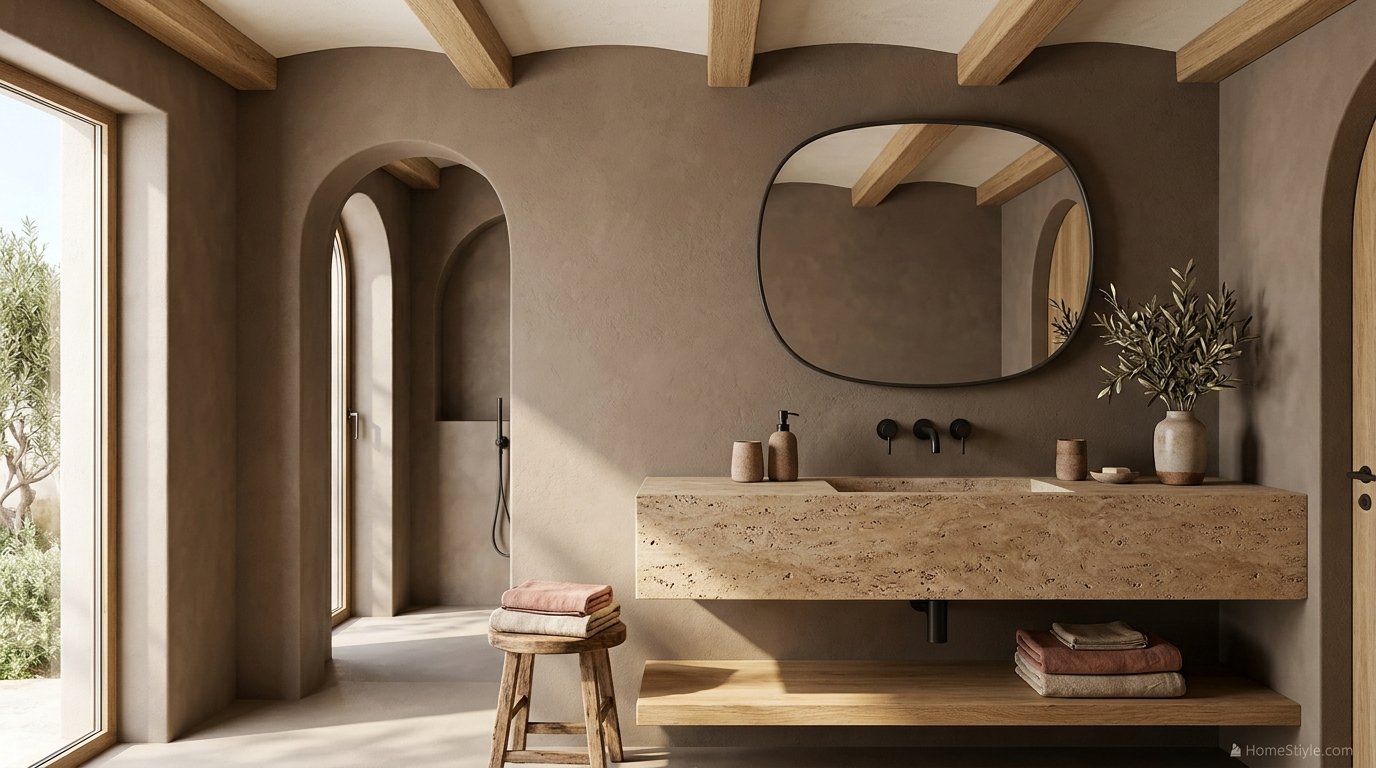
Roman clay is the finish in every mood board right now: a clay based plaster troweled in two thin coats to a suede matte surface with soft cloudy movement.
Its maker is also its strictest critic, and the Color Digest bathroom paint guide quotes the limits in plain language: Roman Clay is not suitable for wet areas like inside showers, full stop.
The same guidance draws the correct conclusion. The finish is a powder room material, or a full bath material only for walls well away from the shower.
The topcoat misunderstanding deserves its own sentence. The sealer makes the wall wipeable and adds protection, but it does not waterproof or stain proof the finish, in the maker’s own framing.
The finish comparison at the AweDeco textured wall comparison agrees from the trade side. Its wet wall verdict gives showers to tadelakt and microcement, with Roman clay filed among the dry wall finishes.
None of this makes Roman clay a bad product. It makes it a zoned product, superb where water never lands and a costly mistake where it does.
Terracotta and Saltillo: The Sealing Law
Real terracotta is low fired, porous clay. Unglazed, it drinks water, stains happily, and holds grout pigment forever, which is why importer guidance treats sealing as law, not advice.
Sealing porous clay tile, in the order that works:
- Seal before grouting. Raw terracotta sealed first cannot absorb grout pigment; grout on unsealed tile stains permanently in the pores.
- Grout with warm toned joints. Sand or warm gray grout suits the register; bright white grout grids the floor into a checkerboard.
- Topcoat after grouting. The second seal locks the joints and sets the sheen, matte for a natural read, satin for easier cleaning.
- Reseal on the water drop test. Water that beads means the seal lives; water that darkens the tile means it is drinking again and the cycle is due, typically every one to two years.
Shower floors are the strict case. Importers themselves prefer glazed tile for direct wet areas, keeping sealed Saltillo for floors and splash zones where its grip and variation shine.
Clean sealed clay with pH neutral products only. Acids etch the sealer and the tile together, and steam mops drive water exactly where the seal was keeping it out.
Glazed Clay, the Porcelain Look, and the Lime Correction
Glazed zellige is clay wearing armor. The glaze makes handmade tiles shower safe while keeping the tonal variation and ripple that machine tile cannot fake.
Choose it in baked clay tones, weathered rose, brick, and pale clay, and the shower gets the material story without the sealing contract.
Keep its grout warm and understated. The variation is the pattern here, and a bright contrasting grout would redraw handmade tile as a grid.
The porcelain look branch copies terracotta in a body that needs no sealing at all. On shower floors and busy family baths, it is the honest engineering choice, and modern versions carry real texture.
Then the correction this topic owes every reader. The seamless plaster in the Moroccan bathrooms all over this search, tadelakt, is a lime plaster, burnished and cured with olive oil soap.
It is not clay, and that is precisely why it works. Lime sets waterproof; clay dries and can re wet, which makes clay repairable and lime durable.
Roundups that file tadelakt under clay hand readers a category error with expensive consequences. If you want the seamless wet zone finish, budget for lime and a specialist applicator, and let clay do its own jobs well.
The Named Paint Ladder, Conflict Printed
Numbers below carry their provenance on purpose. Specification figures and first person build reports are different kinds of evidence, and this ladder keeps them in separate columns of trust.
|
Paint |
Skew |
LRV Strand |
Best Bathroom Use |
|---|---|---|---|
|
Cavern Clay SW 7701 |
Brown rust |
20 in specification sources; near 24 reported by a first person build |
Vanities, accent walls, full warm rooms |
|
Baked Clay SW 6340 |
Brown |
Near 26, build strand |
Paler full walls, small baths |
|
Audubon Russet HC-51 |
Red rust |
Deep accent strand |
Niches, vanity doses |
|
Roycroft Copper Red SW 2839 |
Red |
Near 10, build strand |
Niche only depth |
The Cavern Clay conflict stays visible on purpose. A reader who finds 24 on a build blog and 20 in the specifications deserves to know both exist, rather than a page quietly picking one.
Depth discipline follows from the ladder. Anything near LRV 20 and below is a vanity, niche, or deliberate cocoon choice in a bathroom, because mirrors and steam punish darkness at face height.
Paler clay shades forgive more. They carry humid zone walls in primary baths where the plaster branch cannot go, especially in bathroom rated matte or eggshell formulas.
Warm on Warm: Pairing the Register
Clay’s pairing law is inherited from the register itself. Warm walls take warm everything, and the first cool gray object in the room starts the argument.
Trim and ceilings use creamy warm whites, matched to the wall’s skew. The named system from the cluster research pairs these walls with warm whites in the family of White Dove and Alabaster, never blue whites or grays.
The living room version of this palette shows the same discipline at larger scale, and our clay living room ideas runs clay against warm whites and wood with no cool interruptions.
Metals rank clearly in this register:
- Matte black anchors. Faucets and frames in black give warm plaster and tile their outline.
- Copper is native. It shares clay’s own metal family and ages into the palette.
- Unlacquered brass is welcome. Its patina suits artisan surfaces and warm stone.
- Chrome comes last. It reads cold and clinical against baked earth tones, the one metal that fights the register.
Stone follows the same law. Travertine and warm limestone belong here; cold white marble with blue veining imports a chill the palette then has to argue with all day.
Wood should stay warm and matte: walnut, warm oak, reeded vanity fronts. Yellow stained pine is the one wood to refuse, because it pushes the whole room toward the orange skew.
The neighboring registers show the range of the warm family: our sand living room ideas runs the palette paler and airier, while our oatmeal living room ideas shows its softest neutral end.
Placement by Room
Powder rooms are the plaster showcase. No shower means no wet zone, so Roman clay can cover every wall, sealed near the sink, and deliver the full suede register in the smallest room in the house.
Primary baths split the room. Tile owns the shower, plaster or paint owns the dry walls, and the vanity wall becomes the clay statement through color, finish, or both.
Small bathrooms run the cocoon math. A mid ladder clay on all walls with a warm white ceiling and black fixtures reads intentional and warm, provided the LRV stays at the ladder’s forgiving end.
The bedroom version of the cocoon already proved the math at sleeping scale, and our clay bedroom ideas pairs the same depths with quiet textiles; the bathroom simply adds mirrors and steam to the formula.
Guest baths take the textile version. Clay towels, a ceramic dispenser, and one painted wall deliver the register to a room that gets renovated last.
Start a whole home warm palette from the cluster hub collected on our HomeStiyle home page.
Technique Notes From the Applicators
Plaster quality is hands, not product, and the applicator pages in this search say the quiet parts out loud.
The splash rule from the Wall Magicians Roman clay guide is the one to memorize. Clay is at its best where the air can be humid but water never splashes it, so seal it near sinks and keep showers for other materials.
Roman clay goes on in two thin coats over a smooth, preferably Level 5 wall, with light sanding between coats. Pale colors want plastic knives, because a steel trowel burnishes light clay into shiny drag marks that never disappear.
Judge every clay and lime finish dry, not wet. Both dry lighter than they look during application, sometimes over days, so a sample judged wet is a sample judged wrong.
The same applicator honesty covers repair. Clay dries rather than sets, so it re wets and patches more easily than any other finish here, the soft surface’s compensation.
Care: Living With Porous Materials
Porous beauty has a calendar, and writing it down is what makes the materials practical instead of precious.
Run the water drop test each season on tile and floors. Beading means rest; darkening means the reseal moves from someday to this month.
Wipe clay plaster with a damp cloth and nothing stronger. Waxed or sealed clay wipes clean; unsealed clay marks, which is a placement fact, not a defect.
Ventilation is a material decision in this palette. A fan that actually clears steam protects paint, plaster, grout, and sealer in one habit.
Humidity alone is the gentle case. Steam without direct water is what humid zone finishes are built for, and a fan that clears the room in twenty minutes keeps even dry zone plaster honest.
Watch the mirror line after showers. Condensation that lingers for an hour is the room telling you its ventilation is undersized for the finishes it hosts.
Three Mistakes That Waste the Palette
Mistake one: Roman clay in the shower. The mood board says yes and the maker says no. Believe the maker, and put the finish where it can live for a decade.
Mistake two: grout before sealer. One skipped afternoon at installation becomes a permanent stain map across a handmade floor.
Mistake three: cool interruptions. Chrome fixtures, blue white trim, and gray towels each import the cold register this palette exists to escape. Audit the room for temperature, not just color.
Three Budgets, Three Versions
Paint and textiles. A sorted clay on the walls or vanity, warm white trim, and clay toned towels. The register arrives for the price of paint, and renters can reverse it in a weekend.
One artisan surface. A Roman clay powder room or a sealed Saltillo floor.
Installed plaster pricing spreads widely by applicator. The installed figures in the Norem Contracting plaster finishes guide run 20 to 30 dollars per square foot in one metro, against far lower starting figures elsewhere, so local quotes are the only honest budget.
The full artisan version. Tadelakt in the shower by a specialist, zellige at the vanity, plaster on dry walls, travertine counters. This is the photograph, with the maintenance calendar attached and priced in from the start.
Every version keeps the same order of decisions. Register first, zones second, pairing third, and the care calendar written before the first purchase.
The Finish Comparison for Bathroom Walls
Plasters get compared by photographs, which is exactly backwards. Compare them by water rating, hand, and upkeep, and the bathroom sorts them itself.
|
Finish |
Water Rating |
Surface Character |
Bathroom Verdict |
|---|---|---|---|
|
Roman clay |
Dry zones only |
Suede matte, cloudy |
Powder rooms, dry walls |
|
Limewash |
Dry and humid, rated products |
Chalky, cross hatch clouds |
Dry walls, cottage registers |
|
Venetian plaster |
Humid, sealed |
Polished, marble like |
Accent walls outside splash |
|
Tadelakt (lime) |
Fully waterproof system |
Seamless, burnished |
Showers, tubs, sinks |
|
Microcement |
Waterproof system |
Smooth, contemporary |
Showers and floors |
Read the table by zone before beauty. A finish that fails your zone is not a finish, it is a future renovation with good photography.
Note what the table quietly proves. The only clay based entry is also the only one barred from wet zones, which is a property of clay itself, not of one brand.
Reading Warm Light: Bulbs and Direction
Clay is a warm color judged under warm light in most homes, and the two together can overshoot. Light discipline keeps the register dusty instead of orange.
Keep bulbs at the warm but not amber end of the range. Very warm bulbs pour extra orange onto an orange skew card until the room reads terracotta whether you chose it or not.
North facing rooms mute the register. Choose the browner skew and one rung deeper than instinct, because cool daylight will take the edge off both.
South facing rooms amplify it. Step paler, or toward the brown skew, and judge the sample at midday, when the amplification peaks.
Judge at the mirror as always in bathrooms. Face height is where clay’s warmth flatters skin or fights it, and no other wall in the room matters as much.
Style Directions: Four Ways to Wear Clay
Southwestern revival is the register’s heritage: plaster walls, Saltillo or its porcelain stand in underfoot, Talavera accents in small doses, and black iron hardware.
Mediterranean softens the same kit with arches, travertine, and paler walls. Keep the clay at the vanity and textiles if the room wants air more than cocoon.
Desert modern strips the palette to clay, warm white, black, and one wood. The finish texture carries the interest that pattern carried in the revival version.
The Japandi quiet end takes clay palest, nearly sand, with pale wood and unbroken calm. It is the version for readers who want the warmth with almost none of the color.
All four directions obey the same zone map and pairing law. Style chooses the dose; physics chooses the placement.
From Gallery to Room: The Warm Photography Trap
Warm rooms photograph warmer than they live. Golden hour light, wood heavy styling, and exposure choices push every clay gallery image a half register toward terracotta.
Translate by dose, not by name. Take the photograph’s material list, then choose your paint one rung paler or browner than the image suggests.
Steal the zone discipline you can see: tile where water lands, plaster where it does not, textiles carrying the rest. That arrangement survives every style direction above.
Finally, live with the sample through one steamy week before the full commitment. Warm colors grow on people or grate on them, and a week of mirrors tells you which.
The Vanity Wall as the Statement
If one surface carries the register in a primary bath, make it the vanity wall. It is the wall you face, it sits in the humid zone rather than the wet one, and it frames the mirror where the palette is judged.
A clay vanity against warm white walls inverts the usual scheme and suits doubtful rooms. The color concentrates where the light is best, and the rest of the room stays bright.
A plaster vanity wall in a full bath must respect the splash rule: seal behind the sinks, keep the finish off the shower return, and let tile take the last few inches near the tub.
Frame the mirror in warm wood or black, never chrome. The frame is the palette’s handshake at face height, and a cold frame loses the argument before the wall color speaks.
Costs, Honestly: Reading the Strands
Clay’s costs arrive as strands from different markets, and printing them side by side teaches more than any averaged figure could.
The paint branch is the only simple one: a sorted clay, a primer, and warm white trim cost what any quality bathroom paint job costs, with tinted primer sometimes saving a full coat on saturated shades.
Tile sits in the middle. A US comparison table in the cluster research put terracotta tile at 2 to 8 dollars per square foot for the material, with sealing supplies and the reseal calendar as the real ongoing cost.
Plaster is where the spread lives. One Phoenix contractor lists Roman clay at 20 to 30 dollars per square foot installed; an Indianapolis applicator starts clay walls near 7 dollars; a national cost dataset puts Venetian plaster at 10 to 25 dollars per square foot.
Those numbers do not average into a national price, and any page that averages them is inventing one. They describe different cities, scopes, and wall preparations, which is why the only honest budget is a local quote on your own walls.
Tadelakt sits at the top as a specialist system, priced like the skilled trade it is. If a quote for it arrives near paint prices, the quote is describing something else.
The First Year: A Maintenance Calendar
Month one: live with everything and note where water actually lands. Rooms confess their true zones in the first weeks, and a splash zone is sometimes wider than the plan assumed.
Seasonally: run the water drop test on tile, wipe plaster with a damp cloth, and check the seal line behind the sinks where hands and splashes concentrate.
At one year: reseal the hardest working tile if the test asks for it, touch up the vanity enamel, and replace any textile that has faded out of the palette.
The calendar is short because the zoning was right. Materials asked to do jobs outside their zones generate emergencies; materials inside them generate a page of chores per year.
Frequently Asked Questions
1. What color is clay in a bathroom?
A muted, earthy warm color with more brown than orange. Clay reads like the inside of the pot, dusty and quiet.
It covers four walls without shouting, which is its whole advantage in small bathrooms.
2. What is the difference between clay and terracotta colors?
Saturation and base note. Terracotta is rich and rust first, clay is muted and brown first.
Both pair warm on warm; clay forgives full rooms, terracotta usually starts as an accent.
3. Can Roman clay be used in a bathroom?
Yes, in its zones. The maker places it in powder rooms and on full bath walls well away from the shower.
Seal it near sinks, and keep it out of direct water entirely.
4. Can Roman clay go inside a shower?
No, by the maker’s own statement. Roman Clay is not suitable for wet areas like inside showers.
Showers belong to tile, tadelakt, or microcement, whatever the mood boards suggest.
5. Does the Roman Clay topcoat waterproof the finish?
No. The topcoat makes the finish wipeable and adds protection, but the maker states it does not waterproof or stain proof it.
It also darkens the color somewhat, so test it on a patch.
6. Is tadelakt made of clay?
No, tadelakt is a lime plaster. It is burnished and cured with olive oil soap, and lime is exactly why it can be waterproof.
Clay dries and can re wet; lime sets, which is the whole difference.
7. What plaster is actually waterproof for a shower?
Tadelakt, the lime plaster, applied by a specialist. Microcement is the modern alternative in the same role.
Both are systems with assemblies behind them, not finishes you trowel on casually.
8. Is terracotta tile waterproof?
Not on its own. Terracotta is porous fired clay that must be sealed to resist water.
Sealed and maintained, it serves floors and splash zones well; glazed tile is the importers’ pick for direct wet areas.
9. How do I seal terracotta tile in a bathroom?
Seal before grouting, then topcoat after. The pre grout seal stops pigment staining the pores permanently.
Follow with the finish coat to lock joints and set the sheen, then reseal on the water drop test.
10. When should I reseal terracotta or Saltillo tile?
Every one to two years, or when the test says so. Water that darkens the tile instead of beading means the seal is drinking again.
Floors and splash zones cycle faster than quiet walls.
11. What is the water drop test for tile sealer?
Drop water on the tile and watch. Beading means the sealer lives; a dark spreading patch means the tile is absorbing and the reseal is due.
It takes ten seconds and replaces guesswork.
12. What LRV is Cavern Clay?
20 in specification sources. A first person room build reported near 24, and honest guidance prints both strands rather than merging them.
Judge the color with a physical sample either way.
13. Why do sources give Cavern Clay different LRVs?
Because they are different kinds of evidence. Specifications come from the manufacturer’s color data; build reports come from one room’s light and camera.
The gap is a lesson in labelling sources, not a tie to break silently.
14. What is the palest clay paint for a bathroom?
Baked Clay, reported near LRV 26 as a build strand. It is the ladder’s forgiving end for full walls and small baths.
Paler still, warm whites in the White Dove family carry the walls clay cannot.
15. How do I tell if a clay color skews red, orange, or brown?
Hold the card against plain white paper. Name what you see: red, orange, or brown skew.
Brown skews behave best in bathrooms; orange skews are the ones that read loud at four walls.
16. What white paint goes with clay walls?
A creamy warm white, matched to the skew. The cluster system pairs clay with whites in the White Dove and Alabaster family.
Blue whites and cool grays fight the register from the first morning.
17. Does chrome go with clay bathroom colors?
It comes last in this register. Chrome reads cold and clinical against baked earth tones.
Matte black anchors, copper is native, and unlacquered brass is welcome; chrome imports the temperature clay exists to escape.
18. What metals suit a clay colored bathroom?
Matte black first, then copper and unlacquered brass. Black gives warm plaster its outline; copper shares the metal family; brass patinas into artisan surfaces.
Rank them in that order and the room stays coherent.
19. What grout color suits Saltillo tile?
Sand or warm gray, never bright white. Wide handmade joints are part of Saltillo’s character, and warm grout keeps them soft.
Stark white grout grids the floor into a checkerboard.
20. Can clay plaster handle bathroom humidity?
Yes, away from direct water. Clay plaster handles humid air well; applicators call it best where air is humid but water never splashes.
Seal it near sinks and ventilate the room properly.
21. Where in a bathroom does Roman clay belong?
Powder rooms first, dry walls second. Full walls in a powder room, sealed near the sink.
In full baths, walls well away from the shower, with tile owning the wet zone.
22. How much does Roman clay cost installed?
It spreads by applicator and city. One Phoenix contractor lists 20 to 30 dollars per square foot installed; an Indianapolis applicator starts near 7.
Treat both as dated local strands and quote your own room.
23. Why is Roman clay pricing so variable?
Because the spread is the applicator, not the product. Level 5 preparation, coat counts, travel, and local labor rates move the price more than the plaster itself.
That is why local quotes are the only honest budget.
24. Can I use limewash in a bathroom?
Yes, on dry and humid walls with the right primer. Over painted drywall it needs a mineral bonding primer first.
Keep it out of splash zones unless the product is rated and sealed for them.
25. Roman clay or limewash for a powder room?
Roman clay for suede depth, limewash for cloudy softness. Roman clay is troweled and smoother; limewash is brushed in cross hatch strokes and more forgiving.
Both are dry zone finishes in a bathroom.
26. Real Saltillo or porcelain look tile for a bathroom floor?
Porcelain look for wet floors, real Saltillo for character zones. Porcelain needs no sealing and shrugs off water.
Sealed Saltillo brings variation and grip with a reseal calendar attached.
27. Can clay colors work in a small bathroom?
Yes, at the ladder’s pale end. A mid clay on all walls with a warm white ceiling and black fixtures reads cocoon, not cave.
Deep shades below LRV 20 belong on vanities and niches instead.
28. What sheen should clay bathroom paint be?
Matte or eggshell, in a bathroom rated formula. Gloss turns a warm wall into a mirror and prints every splash.
Satin is the ceiling of acceptable sheen, reserved for trim and vanities.
29. How do I clean clay plaster walls?
A damp cloth and nothing stronger. Waxed or sealed clay wipes clean; unsealed clay marks more easily.
That marking is a placement fact, so unsealed finishes belong where hands rarely reach.
30. Can clay plaster be patched if it marks?
Yes, more easily than any other finish here. Clay dries rather than sets, so it re wets and blends patches invisibly.
Keep leftover material and the color name recorded for exactly this repair.
31. What cleaners are safe on terracotta tile?
pH neutral cleaners only. Acids etch the sealer and the tile together, and steam mops drive water past the seal.
A neutral cleaner and a soft mop keep the calendar instead of shortening it.
32. Do clay colors suit a modern bathroom?
It is a modern organic staple. Warm plaster, black fixtures, and clean lines are the current language.
Keep the styling simple and let temperature and texture do the work.
33. Do clay colors suit a Mediterranean bathroom?
It is the register’s home ground. Plaster walls, arched shapes, travertine, and handmade tile are the Mediterranean kit.
Clay’s muted end keeps the scheme calm instead of theme park.
34. Can renters do a clay bathroom?
Yes, the paint and textile version was built for renters. One sorted clay wall or vanity, warm white accents where allowed, and clay toned towels.
Everything reverses in a weekend.
35. How much does a clay bathroom refresh cost?
From a can and towels to a specialist plaster job. Paint versions sit at the low end; one artisan surface in the middle; tadelakt and zellige at the top.
Prices vary by market and date, so cost locally.
36. Is clay a trend or timeless in bathrooms?
A material classic with trend momentum. Fired clay and earth pigments predate every trend cycle in this search.
The muted register behaves like a warm neutral, which is why it outlasts louder versions of itself.
37. What floor goes with clay walls in a bathroom?
Sealed terracotta, porcelain look, or warm stone. Floors must answer water first, so the wet branches lead.
Warm tones keep the floor inside the palette; cool gray tile imports the wrong register.
38. Can clay pair with marble?
Warm veined marble can; cold blue veined marble argues. Travertine is the safer stone in this palette.
If marble is the dream, choose warm veining and test it against the wall color in daylight.
39. Should the ceiling match clay walls?
Warm white for lift, clay for the drench. Small and powder rooms can take a matching ceiling as a deliberate jewel box.
Primary baths usually keep the creamy ceiling so the walls carry the warmth.
40. How do I test clay paint before committing?
Paper test first, then a sample judged dry. Sort the skew on white paper, paint a large sample, and judge it fully dry in morning and evening light.
Clay judged wet is clay judged wrong.
41. Why does my clay paint look orange?
Usually the skew or the light. Orange skew cards amplify under warm bulbs and south light until the room shouts.
Re sort with the paper test and step toward a browner card or a paler rung.
42. What is the difference between Roman clay and Venetian plaster?
Polish versus suede. Venetian plaster is burnished and glossy, often marble dust based.
Roman clay is matte and suede like, clay based, and troweled in thin coats.
They are cousins, not synonyms.
Conclusion
Clay bathroom ideas reward the reader who sorts before they sample. Define the register first: clay is terracotta with the volume down, muted and brown leaning, and the white paper test names any card’s skew in seconds.
Zone the substances second, because water is the strictest designer in the room: Roman clay belongs to powder rooms and dry walls, porous terracotta lives by the sealing law, glazed clay takes the shower, and tadelakt earns its wet zone place as a lime plaster.
Pair warm on warm third, with creamy whites, black anchors, and stone that shares the palette’s temperature. Write the care calendar before the first purchase, and the room will still look intentional in five years.
Start today with a paper test, a zone sketch, and one sample judged dry; your clay bathroom will be warmer, quieter, and more durable than the mood board promised. Browse our HomeStiyle home page once this room is sorted.
