
Forest green bathroom ideas photograph beautifully, and that is exactly the trap. The moody green bathroom in the picture had a window, a stylist, and daylight.
Your bathroom may have none of those, and forest green is the least forgiving color family in the house about light: the true forest paints reflect between roughly 4 and 10 percent of it.
So treat this as a light problem first, and a color problem second. Bathrooms are small, often windowless, lit by bulbs inches from a mirror, and wet. Every successful forest bathroom is engineered around those four facts, whether its owner knows it or not.
The engineering is a ladder. Vanity first, because a green cabinet against pale walls is reversible and nearly foolproof. Tile second, because glossy green tile returns light instead of swallowing it.
Walls third, because full forest walls are a jewel box commitment that triumphs in powder rooms and caves careless family baths.
Below: the paint table with real LRVs, the ladder, the light budget, the moisture rules nobody prints, partners by mechanism, worked schemes for every bathroom type, and the clinic for caves, black reads, and tile traps.
The Short Answer: A Light Problem First, Then a Ladder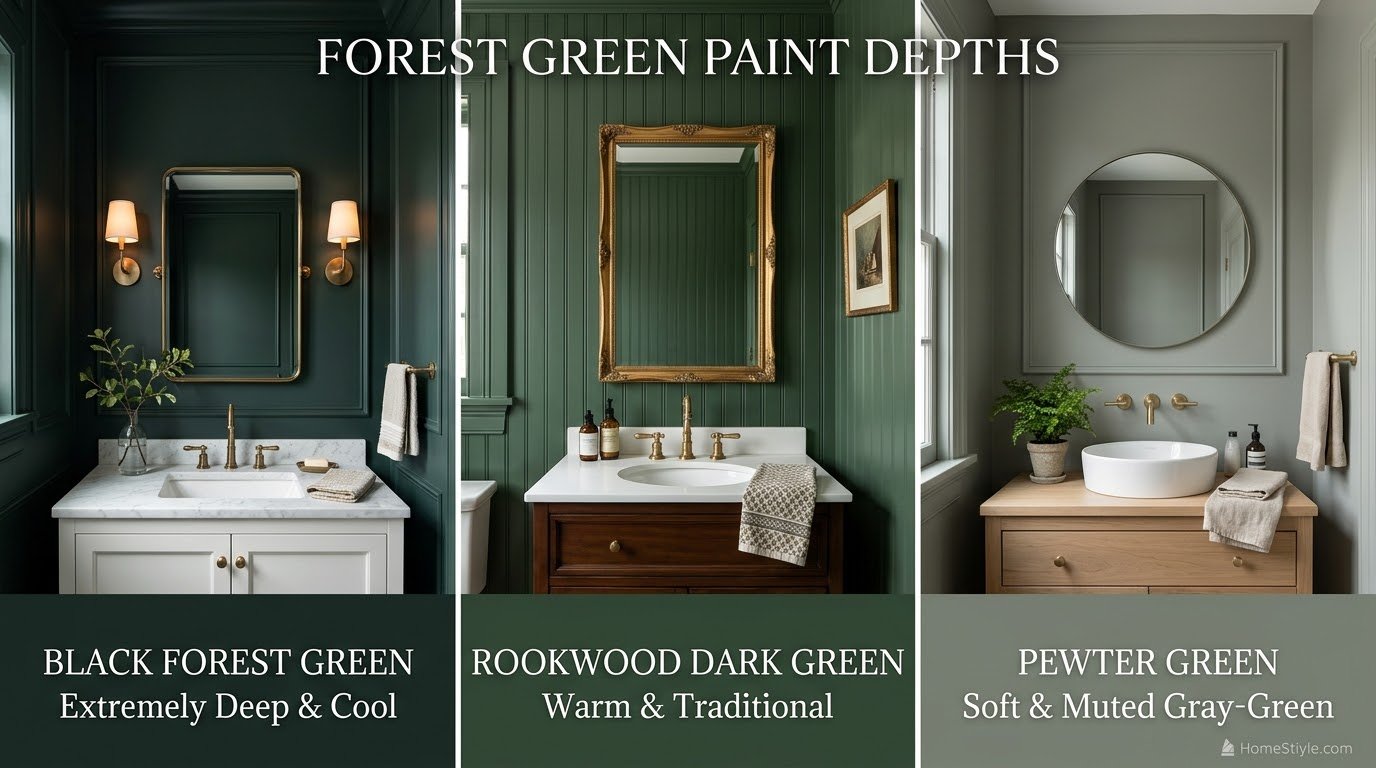
Forest green absorbs light for a living. At the LRVs in the table below, a forest wall returns about a twentieth of the light a white wall returns.
In a living room, windows cover that debt. In a bathroom, the debt is paid by gloss, mirrors, pale stone, and bulb choice, or it is not paid at all.
The ladder spends the color where the return is best. A painted vanity puts forest green at the room’s focal point while white walls keep paying the light bill.
Glossy tile spends more and returns its own light as it spends. Full walls spend everything and must be financed deliberately: sconces, mirrors, pale floors, and a room small enough to read as a jewel box rather than a cave.
Moisture is the silent second budget. Steam, splashes, and a lazy exhaust fan end more dark bathroom paint jobs than taste does. This guide prints the moisture system alongside the color, because in this room they are the same subject.
The Forest Paint Table: Codes, LRVs, and Undertone Families
|
Paint |
LRV |
Undertone family |
Best rung |
|---|---|---|---|
|
Benjamin Moore Black Forest Green HC-187 |
4.85 (technical data) |
Cool, true green (hue 168 degrees) |
Powder room walls; vanities |
|
Benjamin Moore Hunter Green 2041-10 |
4.31 (color guide data) |
Cool, blue gray cast |
Vanities; jewel box walls with a real light plan |
|
Sherwin Williams Shade-Grown SW 6188 |
8 (color diary data) |
Warm, olive bronze soul |
Upper walls above wainscot; vanities |
|
Sherwin Williams Rookwood Dark Green SW 2816 |
10.07 (technical data) |
Warm, yellow leaning (hue 80 degrees) |
The most forgiving full wall forest here |
|
Benjamin Moore Tarrytown Green HC-134 |
Low (guide described) |
Warm, muted, slightly grayed |
Vanities especially; powder rooms |
|
Sherwin Williams Pewter Green SW 6208 |
Muted mid (guide strand) |
Gray softened sage forest |
The on ramp: walls in family baths |
The temperature pair teaches the whole table. On Plan-Home’s technical comparison of Rookwood Dark Green and Black Forest Green technical comparison, Black Forest Green and Rookwood Dark Green sit a full doubling of light return apart (4.85 versus 10.07).
They lean opposite ways (cool green versus warm yellow). Two paints, one family name, different rooms.
Hunter Green is the drama extreme. Hackrea’s Hunter Green guide, with its LRV and tile trap warning guide puts it at LRV 4.31 with a blue gray cast, which is why it reads near black under weak light.
That is a feature in a lamplit powder room and a surprise in a family bath, and the difference is only ever the light plan.
A house caution on these numbers: Benjamin Moore has revised some dark green LRVs upward in recent data (the family’s living room research caught the change).
Every figure here is printed as a dated strand from its source, never blended with another source’s figure for the same paint.
The Surface Ladder: Vanity First, Tile Second, Walls Third
|
Rung |
Commitment |
Light return |
Reversibility |
Cost character |
|---|---|---|---|---|
|
One cabinet |
Walls stay pale and keep paying |
Full: repaint in a weekend |
Paint and hardware |
|
Shower, backsplash, or floor |
Gloss tile returns light as it spends |
Low: tile is a renovation |
Tile and labor |
|
Paint, all or upper walls |
None from the color; financed by fixtures |
Paint reversible, courage permitting |
Paint, plus the light plan |
Rung 1: the vanity
The vanity is the engineered rung, not the timid one. Maximum color presence per unit of light spent: the cabinet carries the forest, warm white walls carry the brightness, a pale counter carries the contrast, and brass hardware carries the warmth.
Perfectly Good Home’s Tarrytown Green guide, with its moisture practice bathroom notes call the green vanity with warm white and brass nearly foolproof, and the field’s best schemes agree by repetition.
Rung 2: tile
Gloss is the point. Zellige and handmade look tile move light across their uneven faces; glossy subway run vertically or floor to ceiling in a shower adds height and return together.
Matching grout calms the field; contrast grout turns it into pattern. Tile also solves moisture permanently where paint merely negotiates with it.
Rung 3: walls
Full forest walls are a powder room’s birthright and a family bath’s negotiation. The jewel box doctrine: in a tiny room, stop apologizing for size and drench it, walls and sometimes ceiling, then light it like jewelry.
In a working family bath, the half wall strategy (white tile wainscot below, forest above) keeps the return and the drama in balance.
The Light Budget: Gloss, Mirrors, Pale Stone, and the Kelvin Band
|
Light asset |
What it returns |
Where it matters most |
|---|---|---|
|
Gloss tile |
Reflected sparkle and movement |
Showers, backsplashes |
|
Large mirror |
A second window’s worth of bounce |
Every rung, especially windowless rooms |
|
Pale counter and porcelain |
The contrast field that reads as brightness |
Vanities and fixtures |
|
White tile wainscot |
Vanity light bounced back at face height |
Family baths |
|
Sconces at eye level |
Flattering, shadow free task light |
Mirror walls |
|
Bulbs at 2700 to 3000K |
Warmth that keeps green rich |
All forest rooms |
The Kelvin band is a rule, not a taste. Design guidance for dark green converges on 2700 to 3000K: above 3500K, bulbs turn forest clinical; below 2500K, they muddy it toward brown.
The bulbs already in the room are part of the paint decision, and swapping them is the cheapest line in the whole budget.
Mirrors are infrastructure here. At forest LRVs the mirror is not decor; it is the room’s second light source, and undersizing it is the most common budgeting error after bulb temperature.
A Little Delightful’s forest and dark green bathroom ideas surface guide makes the same point from the design side, pairing brass framed mirrors with dark walls for exactly the return they give.
Judge the room at night. Forest green’s failure mode is an evening event, in bulb light, at the mirror. Sample on the wall or the vanity door, live with it through one evening routine, and let that reading decide.
Moisture Discipline: Finish, Fan, and Where the Water Lands
Bathroom rated paint is non negotiable at this depth. Mildew resistant bathroom formulas exist because steam rooms grow things; the Perfectly Good Home’s Tarrytown Green guide, with its moisture practice Tarrytown notes make the point plainly, with the exhaust fan checked as part of the same system.
A fan that does not clear a mirror in minutes is not ventilating; it is decorating the ceiling.
Satin is the sheen floor. Dark colors show water spotting and soap splatter more readily than pale ones, and flat finishes hold those marks. Satin or soft gloss on walls, proper cabinet enamel on the vanity, and the marks wipe instead of setting.
Tile where the water lands, paint where it does not. Shower enclosures, tub surrounds, and the splash zone behind sinks belong to tile or solid surface. Paint takes the dry territory. The half wall strategy is this rule wearing its design clothes.
The fan is a paint product. Its failure shows up as peeling at the ceiling line and mildew at the corners, in dark green sooner and more visibly than in white. Budget the fan’s replacement into any forest bathroom plan and the paint will outlive the trend cycle.
Partners by Mechanism: Contrast Engine, Warmth Circuit, Midtone Bridge
|
Partner |
Mechanism |
Best form |
|---|---|---|
|
White porcelain and pale stone |
The contrast engine: the room’s perceived brightness |
Fixtures, counters, tile fields |
|
Brass and bronze |
The warmth circuit for warm and neutral forests |
Faucets, hardware, sconces, mirror frames |
|
Chrome and nickel |
The match for cool blue gray forests |
Fixtures in Hunter Green schemes |
|
Matte black |
The modern edge |
Fixtures, frames, Deco schemes |
|
Walnut and white oak |
The midtone bridge between dark color and white porcelain |
Vanity bodies, shelves, stools |
|
Navy, in one dose |
The cool guest |
A towel set, art, a bath mat |
|
Muted blush |
The anti holiday accent |
Textiles, kept muted beside deep green |
Rocky Mountain Hardware’s dark green bathroom guide, with its pairing table pairing table reaches the same mechanisms from the hardware side, forest green with white marble and aged bronze as the type scheme.
The undertone rule governs the metals: warm forests glow with brass; cool blue gray forests (Hunter Green is the type) sit naturally with chrome and nickel and can look fought by yellow brass.
HomeStiyle’s moss green living room ideas, forest’s muted sibling is the family’s muted sibling and the on ramp made color: a reader who loves forest but fears its LRV can start one family step lighter and arrive at the same warmth by a gentler road.
HomeStiyle’s forest green living room ideas, where the family’s depth rules began holds the depth rules at living room scale, and HomeStiyle’s forest green bedroom ideas, this color in the next room carries the same forest into the bedroom next door.
Schemes: Jewel Box Powder Room, Two Tone Family Bath, Deco, Traditional
1. The jewel box powder room
Black Forest Green or Hunter Green on walls and ceiling, white porcelain, unlacquered brass, a pale stone top, sconces glowing at eye level. The smallest room in the house becomes the one guests describe. Drench without apology; the room’s job is drama in ninety seconds.
2. The two tone family bath
White subway wainscot to half or two thirds height, Shade-Grown or Rookwood above, brass fixtures, warm bulbs, a wood vanity or stool as the bridge.
The wainscot bounces vanity light back at face height, kids and steam are handled by tile, and the forest reads tailored instead of heavy.
3. The vanity statement (primary bath)
Tarrytown or Rookwood on the vanity, warm white walls, marble look counter, brass pulls and faucets, a large mirror, green echoed once in towels or a plant. The foolproof scheme at full size, and the one that survives resale intact.
4. Deco
Emerald leaning forest tile in fan or scallop, black vanity with a white marble top, brass mirror and geometry everywhere. Gloss does the light work; the shapes do the talking.
5. The tile shower room
Glossy forest subway or zellige inside the shower, pale everything else, frameless glass passing the light through. The wet zone carries the color permanently, and the room outside it stays bright enough for morning routines.
The Error Clinic: The Cave, the Black Read, and the Tile Trap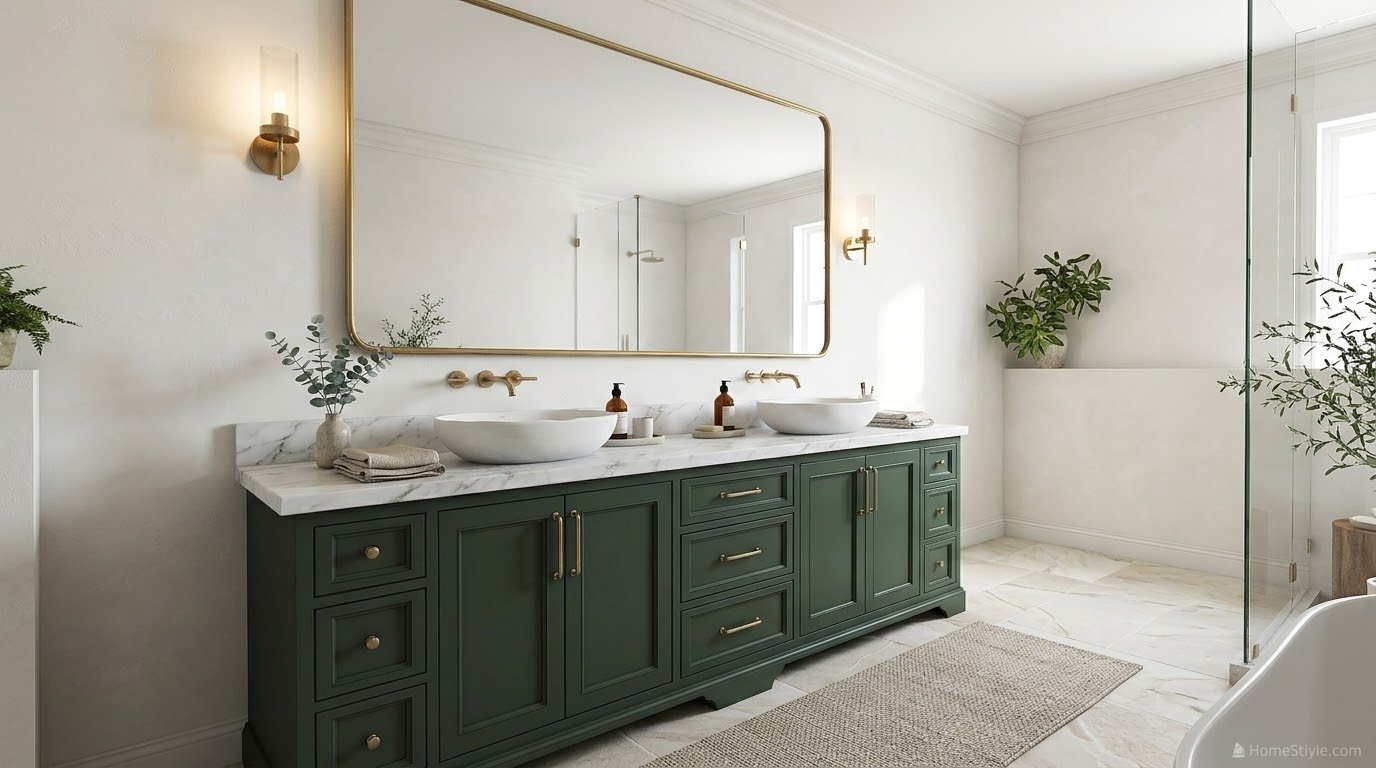
1. The cave
Full forest walls, no window, one ceiling bulb. The color was blamed; the light plan was absent. Fix: sconces at eye level, a bigger mirror, pale floor or wainscot, and bulbs inside the Kelvin band.
If the room still reads cave, retreat one rung: forest on the vanity, walls warm white.
2. The black read
The green vanished. At LRV 4.31, Hunter Green under weak light is functionally black, as its own guides admit. Fix: raise the light, raise the gloss, or raise the LRV: Rookwood at 10.07 keeps its green identity in rooms where Hunter Green surrenders it.
3. The tile trap
Cool forest paint against warm beige or pinkish legacy tile reads dirty on both sides. Hackrea’s Hunter Green guide, with its LRV and tile trap warning names this clash precisely.
Fix: test the actual tile against the chip before buying; warm forests (Rookwood family) mediate better, and some legacy tiles simply veto green until they are replaced.
4. The peeling ceiling line
Steam won. Bathroom rated paint skipped, fan decorative, flat sheen. Fix: the moisture system applied in order: ventilation that clears a mirror, bathroom formula, satin minimum. Color is the last step of the repair, not the first.
5. The spotty vanity wall
Dark paint shows every splash, exactly as promised. Fix: satin sheen, a tile or stone backsplash in the splash zone, and a wipe routine measured in seconds. This is a known property of the color, priced into the scheme from the start.
6. The cold green room
Chrome everywhere, cool bulbs, blue gray forest, gray floor. Every choice leaned the same way. Fix: warm one circuit at a time: bulbs first, then a wood element, then brass in the touch points. Cold is a sum, and it can be subtracted.
The Default Scheme: What Most Readers Should Do
Paint the vanity in Tarrytown Green or Rookwood Dark Green, keep the walls warm white, add a pale counter, brass faucet and pulls, a mirror as large as the wall allows, and bulbs at 2700 to 3000K.
Then echo the green once: towels, a plant, a framed print. That is rung one, executed completely, and it delivers the photograph’s effect at a fraction of its light debt.
Climb only when the first rung bores you. Tile the shower next if a renovation comes; drench the powder room whenever you like, because powder rooms are where forest walls belong by birth.
HomeStiyle’s home for room color guides holds the full color library for the rooms still waiting.
Forest Green by Bathroom Type: Who Gets Which Rung
Powder rooms: rung three, always
The powder room is forest’s home turf. No shower steam, no morning routine, ninety second visits, and guests who reward drama. Drench it, light it like jewelry, and let it be the room people mention at dinner.
Guest baths: rung two or the dressed vanity
Guests get the considered version: a forest vanity with brass and pale stone, or a tiled backsplash carrying the color, with warm white walls keeping mornings easy for visitors who do not know the room. Memorable, not demanding.
Kids and family baths: the two tone discipline
Tile below, forest above, satin everywhere, fan verified. This is the room where the moisture system earns its budget and where white wainscot is not a compromise but the design. Choose Rookwood family warmth; children read it as a forest and adults read it as tailored.
Primary baths: the vanity at full size
Scale rung one up rather than climbing past it. A double vanity in forest with stone counters and a wall sized mirror gives a primary suite the hotel register without surrendering the morning light a working bathroom needs.
Add the tiled shower in green only if the room’s light is genuinely generous.
Rentals and first homes: rung one, reversible
Paint the vanity, swap the hardware, change the bulbs, hang the mirror. Four moves, all reversible or portable, and the bathroom reads renovated. Save the tile ambitions for a home you will keep; the ladder will still be there.
Frequently Asked Questions
1. Is forest green too dark for a small bathroom?
No; small is forest’s natural habitat, with conditions. Tiny rooms read as jewel boxes when the color drenches and the light is planned: sconces, a generous mirror, white porcelain.
What fails is the halfhearted version: dark walls, weak light, gray everything.
Powder rooms can go all in; small family baths should take the two tone or vanity rung.
2. What is the best forest green paint for a bathroom?
Rookwood Dark Green SW 2816 for most bathrooms. At LRV 10.07 with a warm yellow lean, it is the most forgiving true forest here: enough light return to stay green in bulb light, warm enough for brass.
Deep enough for the mood.
Powder room drama briefs can step down to Black Forest Green knowingly.
Pewter Green is the on ramp for the cautious.
3. Black Forest Green or Rookwood Dark Green for a bathroom?
Different depths and temperatures. Black Forest Green HC-187 (LRV 4.85, cool true green) is the jewel box extreme: blacker, cooler, more dramatic.
Rookwood (10.07, warm) returns twice the light and keeps its green identity in ordinary rooms.
Choose Black Forest for lamplit powder rooms and Rookwood anywhere a morning routine happens.
4. Why does my forest green bathroom look black?
Because at LRV under 5, green is a night color. Hunter Green at 4.31 and Black Forest at 4.85 reflect so little light that under weak bulbs the hue simply does not register; the eye reads black.
It is physics, not a bad batch.
Raise light, gloss, or LRV, in that order of cost.
5. Forest green vanity or forest green walls, which first?
The vanity, for nearly everyone. It delivers the color’s presence while pale walls keep paying the light bill, it is reversible in a weekend, and every serious source’s foolproof scheme is built on it.
Walls are the right first move only in powder rooms and in baths with windows and a real light plan.
6. What finish should bathroom paint be in a dark green?
Satin at minimum; bathroom rated always. Dark colors show water spotting and soap splatter, and flat sheens hold those marks.
Bathroom formulas add mildew resistance for steam rooms.
Cabinet enamel on the vanity, satin or soft gloss on walls, and the color survives the room it lives in.
7. Will dark green paint peel in a steamy bathroom?
Only if the system fails it. Steam peels paint where ventilation is decorative and the formula is wrong.
A fan that clears a steamed mirror in minutes, bathroom rated paint, satin sheen, and cure time before the first long shower: with those four, forest paint in a bathroom is a solved problem.
8. Does dark paint show water spots in a bathroom?
Yes, honestly, and it is manageable. Dark surfaces show water spotting and soap splatter more readily than pale ones; the Tarrytown guide says so outright.
Satin sheen wipes clean, a backsplash takes the splash zone, and a ten second wipe is the standing price of the look.
Readers deserve the fact before the paint, not after.
9. What tile goes with forest green walls?
White, pale, and glossy by default. White subway is the classic return engine; pale stone looks and light porcelain bounce the light forest walls absorb.
Green on green tile works inside showers and as wainscot with discipline.
The veto is warm beige or pinkish legacy tile against cool forests, the tile trap.
10. What grout color works with dark green tile?
Match for calm, contrast for pattern. Grout in the tile’s own shade makes a seamless, expensive feeling field and hides the grid; light grout draws the pattern (subway geometry, herringbone) and adds perceived light at some cleaning cost.
In dark green showers, matching grout is the serene professional default.
11. Gloss or matte tile in a dark green bathroom?
Gloss, in a dark bathroom, almost always. Glossy tile is the light plan: it reflects bulbs and daylight back into a room whose walls absorb both.
Matte green tile is a daylight luxury for windowed baths.
Zellige splits the difference, matte in body and glossy in movement.
12. What metal fixtures go with forest green?
By undertone: brass and bronze for warm forests, chrome and nickel for cool ones, black for modern edges. The hardware house pairing table and the design guides converge here.
Rookwood and Tarrytown glow with brass; Hunter Green’s blue gray cast sits naturally with chrome.
One metal family, repeated, is the discipline.
13. Brass or chrome with forest green?
It depends on which forest you chose. Warm yellow leaning greens (Rookwood) were made for brass; the pairing is the field’s type scheme.
Cool blue gray greens (Hunter Green) can look fought by yellow brass and take chrome or nickel cleanly.
Decide the paint’s temperature first and the metal answers itself.
14. What countertop goes with a forest green vanity?
Pale stone: white marble, marble look quartz, or cream quartz. The counter is the scheme’s contrast engine and its light return at working height.
Rocky Mountain Hardware’s pairing table formalizes it: forest vanity, white marble or cream quartz, aged bronze or brushed brass.
Dark counters under dark vanities spend light the room does not have.
15. What colors go with forest green in a bathroom?
White and warm neutrals lead, wood bridges, warm metals glow. Add pale stone, one cool guest dose (navy), and muted blush as the anti holiday accent.
The pairing logic is mechanical: forest absorbs light and leans cool or warm by family, so partners supply return (white), warmth (brass, wood), or rest (neutrals).
16. Forest green or emerald green for a bathroom?
Forest is deeper, earthier, and more traditional; emerald is brighter, bluer, and jewel register. Emerald belongs to Deco and glam schemes and lights more easily; forest belongs to botanical, traditional, and moody schemes and demands the light budget.
Rooms with weak light take emerald’s register more kindly; rooms with a light plan earn forest’s depth.
17. What lighting does a dark green bathroom need?
Layered, warm, and at face height. Sconces flanking the mirror inside the 2700 to 3000K band, a lit mirror or generous reflective surface, and enough total output that an LRV 5 wall still reads green.
One dim ceiling fixture is the cave recipe; light at the mirror is where bathrooms are actually used.
18. What color bulbs suit a green bathroom?
2700 to 3000K, the warm white band. Above 3500K, bulbs turn forest green clinical; below 2500K they muddy it toward brown, per design guidance.
Because bathrooms run on bulbs, the bulb swap is part of the paint job and the cheapest correction when a finished room reads wrong.
19. Can a windowless bathroom be forest green?
Yes, and powder rooms prove it daily. Windowless rooms substitute planned light for daylight: sconces at eye level, a big mirror, gloss where possible, pale porcelain.
The jewel box doctrine was invented for windowless rooms.
What a windowless room cannot survive is dark walls plus a single weak ceiling bulb.
20. Should I paint the ceiling in a forest green powder room?
In a powder room, yes: drenching is the doctrine. Walls and ceiling in one forest makes the tiny room read intentional and expensive, with sconces and brass as the jewelry.
In family baths keep the ceiling white; it is part of the light budget.
The room’s job decides the ceiling.
21. How do I do a two tone forest green bathroom?
Tile or wainscot below, forest above. White subway or paneling to half or two thirds height returns vanity light and takes the splashes; forest paint crowns it.
Shade-Grown above white wainscot is the field tested version.
Cap the tile with a trim line so the junction reads tailored, not accidental.
22. Can I paint my existing vanity forest green?
Yes; it is rung one and the standard entry. Clean, sand, prime for adhesion, and use cabinet grade enamel in satin; hardware off, doors off, thin coats.
The existing vanity in Tarrytown or Rookwood with new brass pulls is the highest value transformation in this entire topic.
23. How much does a forest green bathroom refresh cost?
The vanity rung costs paint and hardware; tile and wall rungs cost renovations. A painted vanity refresh is a few hundred dollars in materials.
Retiling and replumbing price by market and scope.
This guide prints no invented averages; cost your rung at local rates, and expect labor, not color, to dominate every rung above the first.
24. Can a renter do a forest green bathroom?
Yes, at rung one, with permission where required. A painted vanity (where the lease allows), green towels and a bath mat, a plant, and art deliver the palette reversibly; peel and stick products extend it cautiously outside wet zones.
The full forest effect needs the cabinet; everything else is echo.
25. What floor works in a forest green bathroom?
Pale, practical, and large format. Light porcelain or stone look floors return light at the room’s base and forgive water; pale gray porcelain is the small bath guides’ recurring foundation.
Dark green floor tile is a deliberate anchor dose for pale walled rooms, with honest lint and water mark upkeep.
26. Does forest green go with marble?
Yes; it is the classic contrast of the whole topic. White marble’s cool veins against deep green is the hardware guides’ type scheme.
Keep the marble (or its quartz lookalike) on counters and splash zones where its brightness works hardest, and let brass warm the junction.
27. Does forest green go with warm wood?
Yes; wood is forest’s midtone bridge. Walnut and white oak vanities, shelves, and stools sit between dark walls and white porcelain and keep the room organic.
Warm woods also mediate the tile trap when legacy floors or vanities lean warm.
One wood family, repeated, is enough.
28. What towels work in a forest green bathroom?
White first, for contrast and for honesty. White towels read as brightness against forest and show their cleanliness; cream warms the scheme; one navy or muted blush set is the accent rotation.
Dark green towels in a dark green room disappear, which is sometimes the calm goal and never the light one.
29. Can forest green work in a kids bathroom?
Yes, with the two tone rung and satin discipline. Kids baths take splashes and steam at industrial rates, so tile below, forest above, wipeable sheen, and a working fan.
The color hides the room’s chaos better than white does, and children read it as a forest, which is not a complaint.
30. What mirror suits a forest green bathroom?
Large, warm framed, and unapologetic. The mirror is light infrastructure in a forest bathroom, so size is function.
Brass or wood frames supply the warmth circuit; black frames supply the modern edge.
A small decorative mirror in a dark bathroom is a light budget cut disguised as taste.
31. How do I keep a dark green bathroom from feeling cold?
Warm one circuit at a time. Bulbs into the 2700 to 3000K band first, then a wood element, then brass at the touch points, then warm white textiles.
Cold forest rooms are sums of cool choices; each warm substitution subtracts from the chill without touching the paint.
32. What if my existing tile is beige, can I still use forest green?
Carefully, and sometimes not yet. Warm pink beige legacy tile against cool blue gray forests reads dirty; that is the documented tile trap.
Warm forests (Rookwood family) mediate better, and a full test board against the actual tile decides.
Some beige tiles veto forest until a renovation; the honest page says so.
33. Is forest green a trend or timeless in bathrooms?
Timeless roots, trend timing. Deep green bathrooms run from Victorian emerald through Deco to today’s botanical wave; the color is a classic that trends periodically.
What dates is styling around it.
A dosed scheme on the ladder does not expire with a trend cycle.
34. What white pairs with forest green in a bathroom?
Warm white, not blue white. Chantilly Lace class whites and warm creams keep forest rich; stark blue whites can chill cool forests toward clinical.
The hardware and paint guides’ schemes all build on warm white porcelain and paint.
Match the white’s temperature to the green’s family.
35. Can forest green work with black fixtures?
Yes; matte black is forest’s modern edge. Black faucets, frames, and hardware against deep green read tailored and Deco adjacent, especially with white stone.
Keep the rest of the light budget generous, because black fixtures return nothing; they spend contrast, they do not earn light.
36. How do I add forest green without renovating?
In echoes and one anchor. Green towels, a plant wall, art, a painted stool or mirror frame, then the vanity when commitment grows.
Echoes teach the eye the palette; the anchor (vanity or a tiled backsplash) makes it a scheme.
Echoes alone read as accessories; one anchor makes them a decision.
37. What plants suit a forest green bathroom?
Humidity lovers: ferns, pothos, eucalyptus in the shower. Green on green is the botanical scheme’s living layer, and bathroom humidity suits them.
In windowless rooms choose low light tolerant plants or rotate them to a window weekly; the plant is also a light honesty test.
38. Does dark green make a bathroom look smaller?
It trades spaciousness for intention. Dark color recedes visually in some readings and encloses in others; in small bathrooms the honest answer is that forest makes the room feel deliberate rather than larger.
Mirrors, gloss, and pale fixtures decide whether that reads as jewel box or as cave.
39. How do I test forest green paint in a bathroom?
On the wall or vanity door, at night, doing your routine. Forest green’s verdict is delivered in bulb light at the mirror.
Live with the sample through an evening and a morning, hold tile and counter materials against it, and check it against any legacy tile in the room.
Chips lie kindly; evenings do not.
40. What is the difference between forest green and hunter green?
Hunter is forest’s cool, blue gray branch. Hunter Green 2041-10 (LRV 4.31) leans blue gray and traditional; the forest family spans warmer yellow leaning members like Rookwood.
Think of hunter as one named resident of the forest family, its coolest and darkest, rather than a synonym for all of it.
41. Can I use forest green in a shower?
In tile, yes; in ordinary paint, no. Shower walls are tile’s home ground, and glossy forest tile inside a shower is one of this topic’s best schemes.
Standard wall paint does not belong in direct water; specialty coatings are a professional conversation.
Tile where the water lands is the standing rule.
42. What backsplash works behind a forest green vanity?
Tile or stone, taking the splashes the paint should not. A green tile backsplash doubles the vanity’s color with a wipeable face; white subway or a stone slab keeps the contrast engine running.
Either way the splash zone graduates from paint, which is the moisture system’s whole point.
Conclusion
Forest green bathroom ideas resolve into an order of operations: budget the light, climb the ladder one rung at a time, and run the moisture system like it matters, because in this room it does.
The color is the reward at the end of that discipline, not a substitute for it.
The default stands: a Tarrytown or Rookwood vanity, warm white walls, a pale stone counter, brass at the touch points, the largest mirror the wall allows, and bulbs inside the warm band. One rung, executed completely, beats three rungs done halfway.
Then climb when ready. Tile the shower in gloss, drench the powder room without apology, and let the deep paints read as green because the light was planned before the color was poured. That is how the photograph happens in a real bathroom.
