
What Champagne Actually Is: A Finish First
As a tone, champagne strikes a balance between beige, gray, and gold, with a subtle touch of sparkle. That is the definition in Danetti guide to champagne tones as the new neutral, and it is the honest one.
As a paint, champagne is a named product family with real codes, light values, and a peach gold undertone that behaves differently in every light.
As a metal, champagne gold is the paler, softer gold: brushed or satin, gleaming gently beside lamplight instead of glaring under it.
As a fabric, it is chenille and velvet with a low sheen, plush first and shiny second. The fabric does more glamour work than any accessory.
The Paints: Named Champagnes by LRV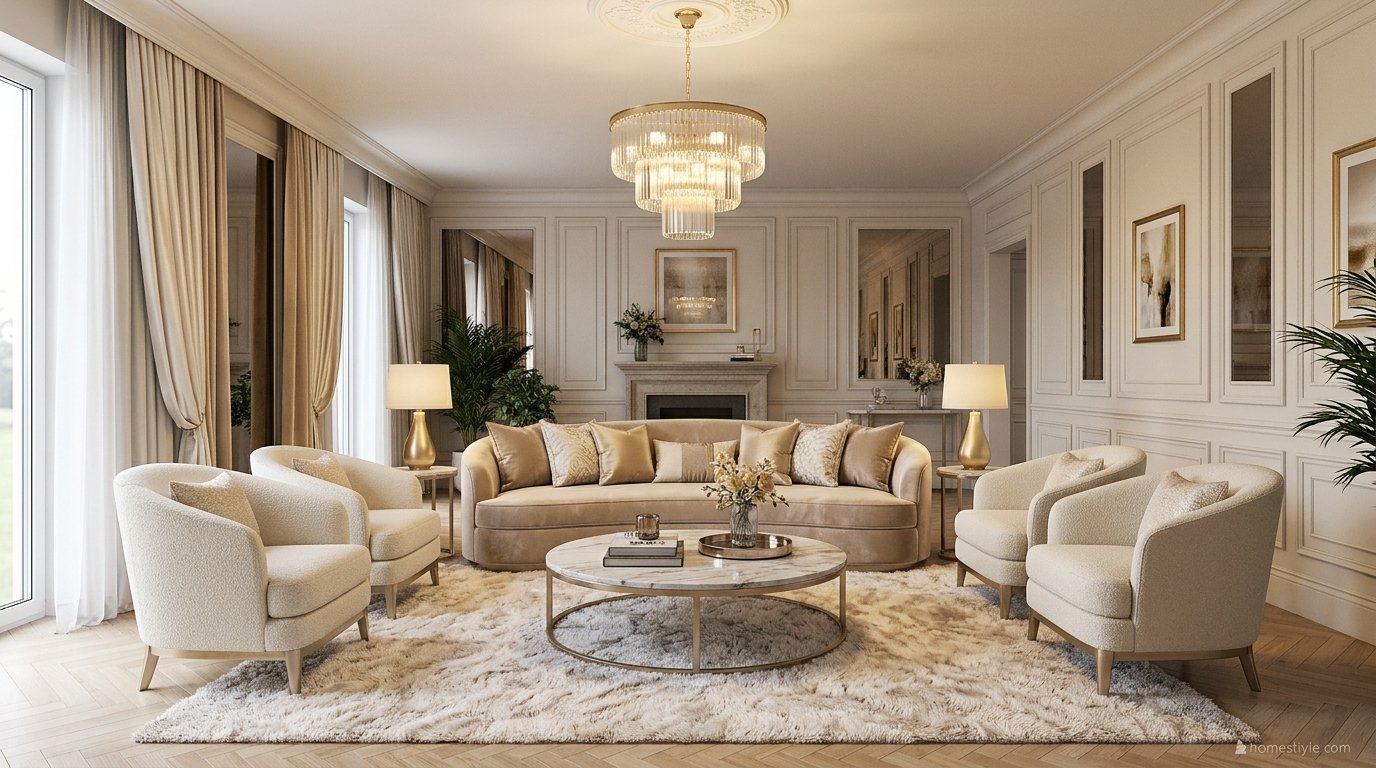
LRV means light reflectance value, the percentage of light a color reflects. Champagne paints sit high on the scale, which is why the rooms feel bright and dressed.
One brand sells the name literally. Sherwin Williams Champagne SW 6644 is the reference paint, and its numbers carry a warning this section will not hide.
|
Paint |
Brand |
LRV |
Best use |
|---|---|---|---|
|
Champagne SW 6644 |
Sherwin Williams |
about 78 to 79 |
Pale glam walls, bright rooms |
|
Champagne 1424 |
Behr |
about 71 |
Softer walls, less peach risk |
|
Champagne Wishes M280-3 |
Behr |
about 68 |
Mid pale walls, tonal schemes |
|
Clay Beige OC-11 |
Benjamin Moore |
about 62 |
The quieter neighbor, low chroma |
|
Accessible Beige SW 7036 |
Sherwin Williams |
58 |
The deep layer under champagne |
The LRV for SW 6644 is reported two ways: plan-home color database comparison of Sherwin Williams Champagne and Benjamin Moore Clay Beige computes 78.11 from manufacturer RGB data, while MyPerfectColor page for Sherwin Williams SW 6644 Champagne reports 79.49.
This page prints about 78 to 79 and never merges them. Wild Fox Painting card for Sherwin Williams Champagne SW 6644 rounds the same color to about 78, with undertones of soft peach and muted gold.
The number that matters most is not the LRV. It is the chroma: plan-home puts SW 6644 at 58 percent saturation, against 28 percent for Clay Beige.
That is why champagne can drift peach in warm light while ordinary beige sits still. The glow and the risk are the same property.
Wild Fox also names the closest Benjamin Moore match: Hazelnut 2161-60. If the Sherwin Williams name is out of stock, that is the stand in to sample.
Sampling Champagne Paint: The Four Checks
Check one: the peach test. Hold the dried swatch beside a true white card in daylight. If the edge between them reads salmon, the room will read peach at wall scale.
Check two: the dusk test. View the swatch at the hour the room goes cold. Champagne should warm up, not gray out, as natural light leaves.
Check three: the bulb test. Switch your actual lamps on. Bulbs above 3000K or bargain warm bulbs with a green cast both distort this family more than most.
Check four: the neighbor test. Hold the swatch against your floor and largest fabric. Champagne negotiates with orange woods worst of all; know the verdict before the first gallon.
The Metal: Champagne Gold and the Dose Rule
Champagne gold lives on small hard surfaces: furniture legs, lamp bases, picture frames, tray tables, and the arms of one statement light.
The luxury field works by a ratio: about 60 percent matte base, 30 percent mid tones and soft textiles, and 10 percent shine. The cap is the secret.
Brushed and satin finishes gleam; polished finishes glare. In a pale room, glare reads cheap faster than any other single choice.
Keep to two metal finishes at most. Champagne gold as the primary, and matte black allowed to join as grounding rather than as a second shine.
Smoked mirror is the field’s second reflective surface. Used on a console or tray table, it bounces soft light without the full mirror flash.
Finishes Compared: Where Each Shine Belongs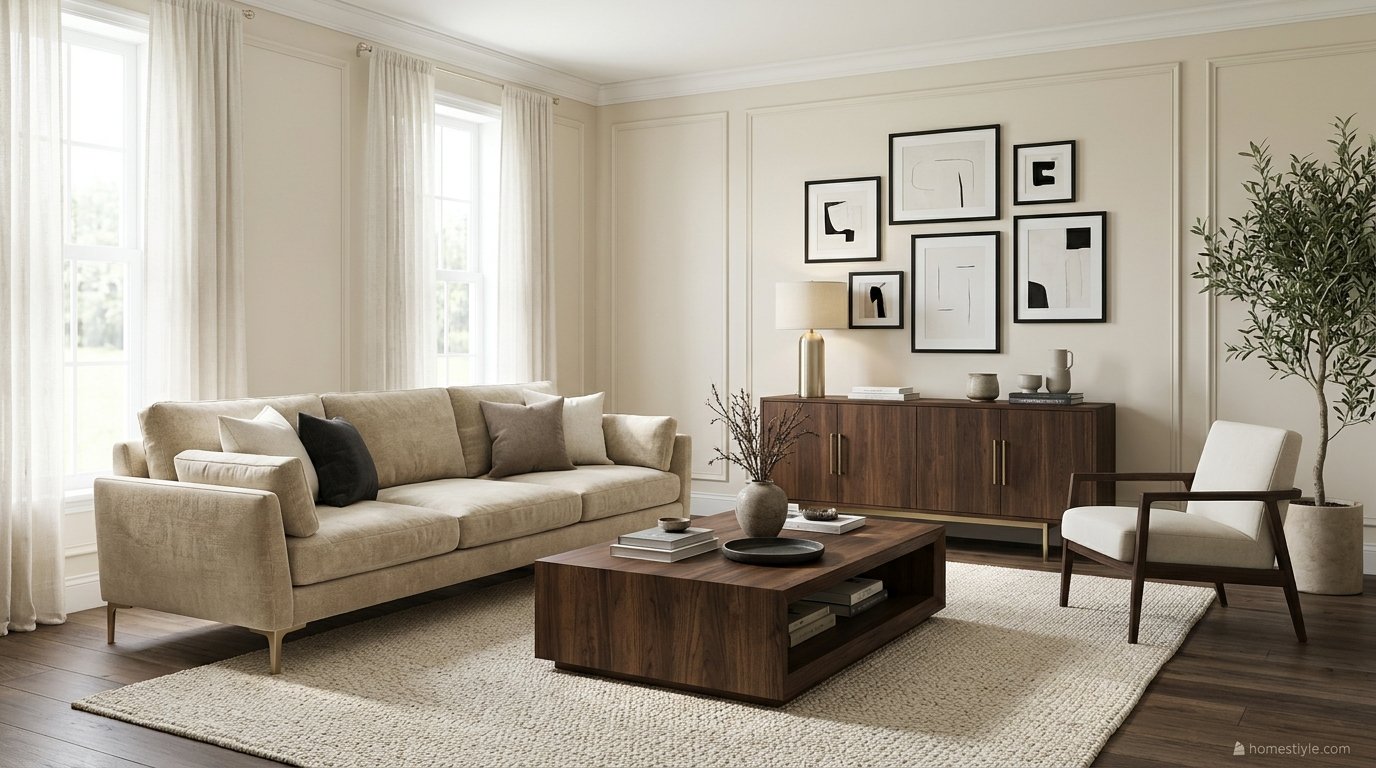
|
Finish |
Shine level |
Best surfaces |
Risk |
|---|---|---|---|
|
Brushed champagne gold |
Low, soft gleam |
Legs, lamp bases, frames |
Almost none; the default |
|
Satin brass |
Low to medium |
Chandeliers, handles, trays |
Reads yellow beside champagne gold |
|
Polished gold |
High glare |
One small accent only |
Cheapens pale rooms fast |
|
Smoked mirror |
Medium, diffused |
Consoles, tray tables |
Fingerprints, flash glare |
|
Clear mirror |
High |
Above consoles, opposite windows |
Doubles visual clutter |
|
Matte black |
None |
Frames, side tables, legs |
Grounding, not a shine |
Match the metal to the room’s light: brushed finishes forgive bright rooms, while polished pieces need dim, warm light to stay elegant.
Two finishes can share a room when one is clearly primary. The eye forgives a supporting metal; it does not forgive a tie.
The Fabric: Chenille, Velvet, and Sheen
Chenille is the signature champagne fabric. Danetti guide to champagne tones as the new neutral builds its champagne sofa in a light, fizzing champagne chenille, piped in a contrasting mocha.
Velvet is the second voice: deeper sheen, more drama, and pile marks as its honest maintenance cost. It suits armchairs and cushions more than family sofas.
Matte textiles are the balancing act. Boucle, cashmere style throws, and linen keep the room plush without adding shine the dose rule has to count.
Float the sofa away from the wall where the plan allows, and layer a champagne toned rug beneath it to define the seating zone, as the Danetti stylists do.
Dress the sofa with cushions in warm caramel and rich chocolate brown, plus a single contrasting jewel tone such as ruby or emerald. That is Danetti’s own formula.
The Grounding Rule: Dark Pieces Keep It Honest
Ground the palette with matte black or dark walnut accents to stop the scheme feeling one note. The instruction comes straight from the Danetti guide’s living room section.
Dark oak does the same work in the retailer’s seasonal recipe, where champagne tones are accented with rich dark oak and metallic strips.
The grounding pieces are matte, not shiny: a walnut sideboard, a black framed print line, a dark wood coffee table. They absorb light while everything else returns it.
Without grounding, pale plus shiny plus soft adds up to bridal. Break any one of the three and the room returns to glamorous.
Grounding also fixes the photograph problem: pale rooms blow out on camera because nothing gives the exposure a dark reference. Two matte dark pieces and the room photographs the way it actually looks, which matters for anyone staging or selling.
Walls, Trim, and Ceiling
Champagne walls want flat or eggshell paint. A glossy wall finish doubles the room’s shine budget before a single accessory arrives.
Trim goes warm white one step lighter for lift, or the same champagne in satin for the drenched cocoon. Blue white trim makes champagne look peach by comparison.
Color drenching in champagne ivory plaster is the luxury version: walls, ceiling, and large upholstery in one tone, with satin brass as the 10 percent accent.
Sheen steps do the separating in a drench: flat walls, satin trim, matte textiles, and the metal dose counted as carefully as in any other scheme.
Pairings: Guests, Woods, and Second Metals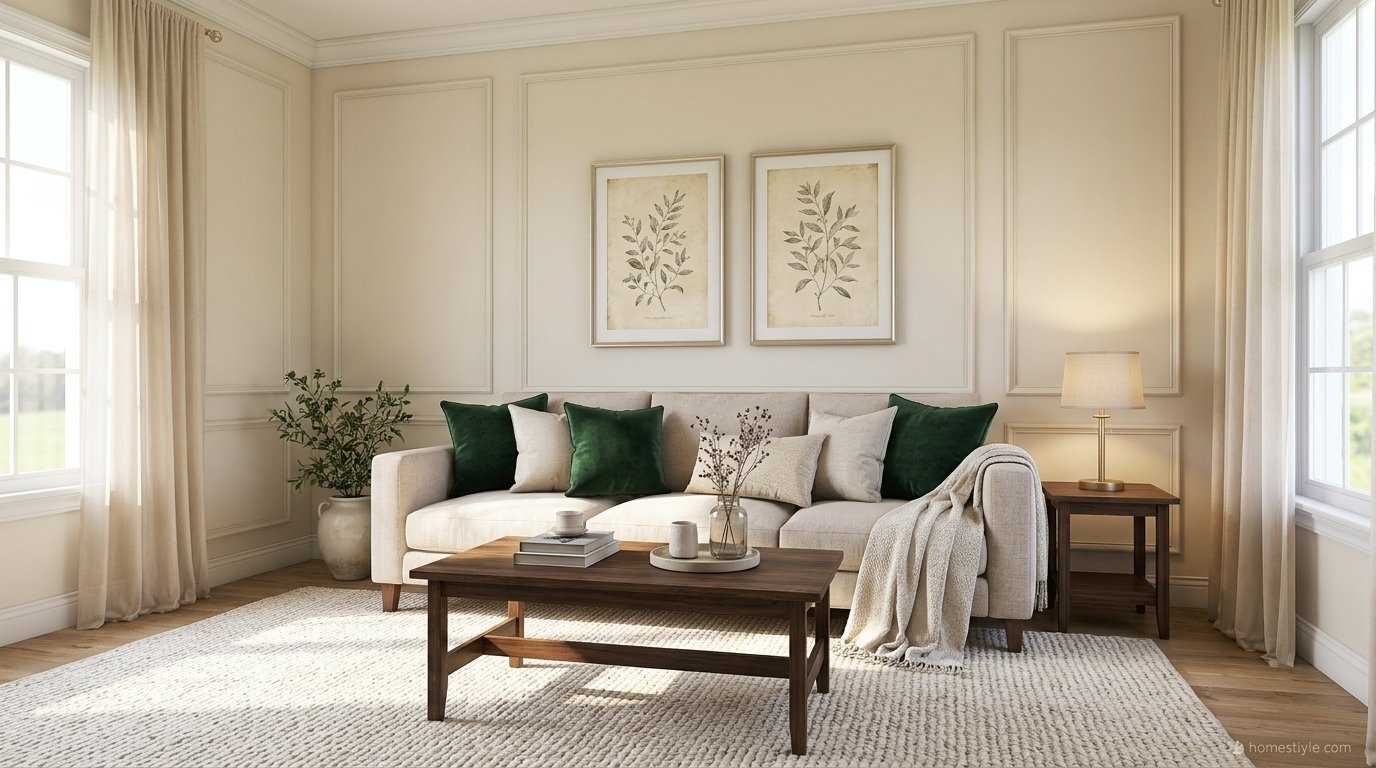
Accent guests arrive one at a time. Emerald and ruby are the jewel guests, navy is the cool contrast, and chocolate and caramel are the warm family.
Forest green living room ideas shows what one deep guest color does at full room scale. In a champagne room, that depth belongs in cushions and art, not on the walls.
Blush is the romantic partner: blush cushions on ivory seating keep a champagne room from reading flat, in the villa register the Dubai showcases use.
Clay living room ideas is the earthy cousin in the cluster: clay warms a house through matte pigment, where champagne warms it through finish and light.
Gray can join if it is a warm gray. Blue grays clash with the peach undertone, which is why champagne is often chosen to fix rooms that gray made cold.
Champagne and Its Cousins
|
Color |
Character |
Finish association |
Best room |
|---|---|---|---|
|
Champagne |
Pale beige, peach gold glow |
Sheen, brushed metal |
Glam, formal, quiet luxury |
|
Beige |
Uniform warm neutral |
Matte, flat |
Traditional, safe schemes |
|
Cream |
Light, yellow, soft |
Matte, smooth |
Classic, layered with champagne |
|
Oatmeal |
Grayed, fibrous, calm |
Matte texture, no shine |
Scandi, organic modern |
|
Sand |
Sunny, mineral, yellow |
Matte grain |
Coastal, Mediterranean |
Sand living room ideas covers the sunny mineral cousin: sand warms through grain and pigment, with no metallic reading at all.
Oatmeal is the closest cousin and the clearest contrast: oatmeal is texture first and proudly matte, where champagne is finish first. The two can share a house, room by room.
Beige is the safe wall that champagne out glows and out risks. The chroma numbers say it plainly: 58 percent against 28 percent in the plan-home comparison.
Light: Where Champagne Earns Its Name
Danetti’s phrase is exact: champagne is flattering in natural light and shimmers beside the glow of a lamp. This color is designed for the evening room.
Bulbs at 2700K to 3000K keep the gold alive. Cool daylight bulbs gray the palette out and make the peach undertone look like a mistake.
Layer the light: one statement fixture (crystal or champagne gold), two lamp sources at seat height, and candlelight for the final register.
In north facing rooms the warm undertone corrects the blue gray cast, which is why champagne is a standard fix for rooms that feel cold.
Basement living room ideas works the same problem below ground: warm values, layered sources, and surfaces that return light softly instead of absorbing it.
Branches: Small, Formal, Rental, Holiday
The Small Room Branch
High LRV walls keep a small room bright, and the tonal palette avoids visual chop. The metallic dose shrinks further here, because reflective surfaces multiply visually.
Let one hero piece carry the glamour at this scale: a statement chair, a light, or a champagne gold coffee table. Everything else stays quiet.
Small rooms also benefit from champagne’s evening shift: most small living rooms are used hardest after work, exactly when this palette is at its best.
The Formal Room Branch
This is champagne’s home turf: symmetry, a chandelier centered on the seating, paneled or plaster finished walls, and the jewel guest at full cushion strength.
Formal does not mean fragile. Performance chenille and washable throws keep the room usable, which is what separates a living room from a showroom.
The Rental Branch
Textiles and accessories only: champagne cushions and a throw, one gold toned lamp, a mirrored tray, and candles. Nothing fixed, everything movable.
The hero piece doctrine suits rentals perfectly, because the hero is furniture, not construction, and it leaves with you.
The Open Plan and Entertaining Branch
Champagne was made for entertaining light: guests arrive at dusk, lamps come on, and the room’s glow does the hosting.
Zone the open plan with the rug and the chandelier, not with color changes. One champagne family runs through, and each zone takes a different finish mix.
Keep the shine count per zone, not per room. An open plan space can hold two or three metallic moments if each seating group owns only one.
Bar carts and tray tables are the branch’s natural furniture: small, hard, reflective, and exactly the surfaces the dose rule was written for.
The Holiday Branch
Champagne gold is the modern holiday metallic: metallic tree decor, pillow trims, and garlands over the everyday room, festive but polished.
It pairs with whites, soft pinks, and light neutrals for the season, then the sparkle layer comes off in January and the room returns to quiet luxury.
Daylight vs Lamplight: The Two Room Test
Champagne is really two colors: a pale warm beige by day and a glowing gold beige by night. Judge it in both or do not judge it at all.
In bright south light the peach undertone stands forward and the chroma shows. This is where yellow and peach surprises are born.
Under warm lamplight the same paint settles and glows, which is why designer photographs of champagne rooms are so often evening shots.
The test protocol is simple: swatch two walls, live with them 48 hours, and check at breakfast, mid afternoon, and after dark under your own bulbs.
If the color fails only at midday, sheers or a rug may fix the light rather than the paint. If it fails at night, the paint itself is wrong for the room.
Pattern, Art, and Mirror Placement
Champagne rooms take pattern quietly: a tonal stripe, a faded traditional rug, or one silk blend cushion print in the palette’s own colors.
Art supplies the graphic rest point a pale room needs. Deep framed prints, a black frame rail, or one moody landscape over the sofa does the grounding work at eye level.
Mirrors belong where hands do not land: above consoles, behind sofas, and on the wall opposite a window, where they return daylight into the room’s middle.
A mirrored coffee table is the dose rule’s hardest test. It is a large reflective surface, so it spends most of the room’s shine budget in one piece.
Pampas grass and dried stems are the field’s softener: matte, tall, and cheap, they break up reflective clusters and keep glam from hardening.
The Budget Doctrine: One Hero Piece
Beautiful Solutions guide to a champagne living room on a lemonade budget states the strategy in its title: a champagne living room on a lemonade budget, built on one hero piece of furniture.
Choose the hero first (a dramatic armchair, a statement light, a marble or champagne gold coffee table) and buy it as well as the budget allows.
Everything else can be affordable: oversized cushions in linen or silk blends, cashmere style throws, candles in elegant holders, and fresh flowers in clear glass.
Paint is the cheapest champagne of all. One pale gold beige on the walls changes the room’s register before any furniture decision is made.
Care: Pale Upholstery and Mirrored Pieces
Pale glam fabrics follow the pale sofa rules: vacuum weekly, blot spills without rubbing, and keep a washable throw on the main seat.
Know the care code before buying: W water based, S solvent, WS either, X vacuum only. Velvet adds pile care: brush with the nap and expect shading marks.
Dark denim dye transfer shadows pale chenille exactly as it does linen. The throw on the seat is the cheap insurance.
Mirrored and smoked glass pieces fingerprint visibly. Microfiber and glass cleaner weekly is the honest cost, and placing mirrors where hands do not land halves it.
Metal finishes want a dry cloth, not polish, on brushed surfaces. Polish builds shine contrast that breaks the brushed uniformity the dose rule depends on.
Three Worked Champagne Rooms
The budget glam room. Behr Champagne walls, an ivory sofa with caramel and chocolate cushions, one champagne gold coffee table as the hero, and a walnut sideboard grounding the shine.
The north facing fix. SW 6644 tested at dusk, chenille cushions, satin brass lamps at 2700K, smoked mirror console, and one emerald cushion pair as the jewel guest.
The formal tonal room. Champagne drench with satin trim, a crystal chandelier, ivory seating, blush cushions, dark oak tables, and black frames as the graphic rest point.
Champagne Living Room Mistakes
Shine everywhere. Metallic on large surfaces breaks the dose rule and reads bridal or hotel lobby. Cap shine near 10 percent.
No dark grounding. Pale plus soft plus shiny with nothing matte and dark is the bridal formula. Add walnut or black first.
Polished everything. Polished metal glares in pale rooms. Brushed and satin finishes are the champagne standard.
Skipping the swatch. Champagne’s peach and yellow surprises are light dependent. They only show at full swatch scale, morning and evening.
Three metals competing. Champagne gold, polished brass, and chrome together read as a showroom clearance. Two finishes maximum.
Same finish on every surface. One color in one finish reads as a matched set. Vary finish and texture, not just shade.
Before You Commit: The Shine Checklist
- Pick the paint by numbers. LRV and chroma first, name second.
- Swatch at full size. Two coats, two walls, morning, evening, and lamplight.
- Count the shine. Metallic and mirror near 10 percent of surfaces, listed piece by piece.
- Ground it dark. Walnut, dark oak, or matte black in at least two matte pieces.
- Choose one jewel guest. Emerald, ruby, or navy, repeated in at least two places.
- Keep metals brushed. Satin or brushed finishes only, two metals maximum.
- Buy the hero well. One statement piece at full quality; accessorize affordably around it.
Frequently Asked Questions
What color is champagne in a living room?
A pale warm beige with a gold and soft peach undertone, named for the wine’s color. Danetti defines the tone as a balance between beige, gray, and gold with a subtle touch of sparkle.
As paint, Sherwin Williams sells it literally: Champagne SW 6644, at an LRV of about 78 to 79.
Which paint colors are actually named champagne?
Sherwin Williams Champagne SW 6644 (LRV reported 78.11 by plan-home and 79.49 by MyPerfectColor, printed here as about 78 to 79, never merged).
Behr sells Champagne 1424 (LRV about 71.2 per MyPerfectColor) and Champagne Wishes M280-3 (LRV about 68.4 per plan-home). Benjamin Moore’s closest match to SW 6644 is Hazelnut 2161-60 per Wild Fox Painting.
What is the LRV of Sherwin Williams Champagne SW 6644?
Sources disagree slightly: plan-home computes 78.11 from manufacturer RGB, MyPerfectColor reports 79.49, and Wild Fox Painting rounds to about 78. Print it as about 78 to 79.
Either way it is a very light color that will read almost creamy white in bright rooms and warm beige in dim ones.
Is champagne a warm or cool color?
Warm. SW 6644 carries soft peach and muted gold undertones (Wild Fox Painting), at a hue of about 35 degrees.
Its surprise is saturation: plan-home puts its chroma at 58 percent, far higher than quiet beiges, which is why champagne can drift peach or yellow in warm light.
What is champagne gold, and how is it different from yellow gold?
Champagne gold is a muted, paler gold with a beige pink softness, between yellow gold and rose gold. In rooms it appears as brushed or satin metal on legs, frames, lamps, and tables: the gleam without the glare.
Yellow gold is brighter and more formal; champagne gold is the quieter, modern dose.
What colors go with a champagne sofa?
Danetti’s own styling rule: cushions in warm caramel and rich chocolate brown, plus a single contrasting jewel tone such as ruby or emerald.
Cream and ivory layer tonally, walnut and matte black ground it, and blush is the soft romantic partner.
What color walls go with a champagne sofa?
One value step away from the fabric: warm white or a pale champagne paint (LRV about 78) behind a mid tone sofa fabric, or a deeper beige like Accessible Beige SW 7036 (LRV 58) when the sofa is pale.
Same value walls and sofa are how the room turns into one beige note, the exact failure Danetti’s stylists warn about.
How much metallic is too much in a champagne living room?
Use the ratio the luxury field works by: roughly 60 percent matte base, 30 percent soft textiles and mid tones, 10 percent shine. Champagne gold belongs on small hard surfaces (legs, frames, lamp bases, tray tables).
When shine covers large surfaces, the room stops reading luxury and starts reading bridal or hotel lobby.
Why does my champagne room look peach?
Champagne paint is more saturated than it looks on the chip (58 percent chroma for SW 6644 per plan-home), and warm light amplifies its peach undertone.
Test at full swatch size on two walls, check it at night under your actual bulbs, and if it still blushes
Step to a quieter neighbor like SW Lightweight Beige (LRV about 59) or BM Clay Beige OC-11 (LRV about 62).
Why does my champagne room look yellow?
The gold undertone plus warm bulbs plus south facing sun is the usual stack.
Cool the light first (stay at 2700K to 3000K, never warmer looking specialty bulbs), then add the cooling guests: gray veined marble, smoked mirror, or one blue gray textile.
If the paint itself is the problem, its high chroma is the cause and a lower chroma beige fixes it.
How do I stop a champagne living room looking bridal?
Three moves: ground it with dark matte pieces (walnut, matte black, dark oak, per Danetti and its Press Loft recipe), keep shine brushed and rationed, and add one non sweet element: a jewel tone cushion, a graphic black frame line
Or leather. Bridal comes from pale plus shiny plus soft everywhere; break any one of the three.
How do I get a champagne living room on a budget?
The lemonade budget doctrine (Beautiful Solutions): buy one hero piece well (a statement chair, a light, a coffee table) and accessorize around it affordably.
Paint is the cheapest champagne of all: one pale gold beige on the walls, then cushions, candles, and a single metallic tray carry the glam.
Does champagne work in a small living room?
Yes: LRV near 78 walls keep the room bright, and the tonal palette avoids visual chop. Keep the metallic dose even smaller in a small room, because reflective surfaces multiply visually, and let one hero piece carry the glamour.
Does champagne work in a north facing living room?
Yes, and it flatters cool light: Danetti notes champagne is flattering in natural light and shimmers beside lamp glow. The warm peach gold undertone corrects the northern gray cast.
Test the swatch at dusk, when north rooms go coldest, before committing.
Champagne vs beige: what is the difference?
Beige is the flat, uniform family; champagne is beige with a gold peach glow and a suggestion of sparkle, in paint measurably more saturated (SW 6644 at 58 percent chroma vs BM Clay Beige at 28 percent, plan-home).
Beige is the safer wall; champagne is the warmer, richer, riskier one.
Champagne vs cream: what is the difference?
Cream is lighter, yellower, and matte; champagne is slightly deeper, peachier, and associated with sheen. They layer well: cream walls with champagne textiles, or champagne walls with cream upholstery, one value step apart.
Champagne vs oatmeal: what is the difference?
Oatmeal is the matte, fibrous, grayed member of the family, texture first; champagne is the glowing, golden member, finish first. Oatmeal suits Scandi and organic rooms; champagne suits glam and formal rooms.
They are cousins and can share a house room by room.
What fabrics suit a champagne living room?
Chenille is the signature (Danetti builds its champagne sofa in a light fizzing champagne chenille), then velvet for sheen, silk blends for cushions, cashmere and boucle for matte contrast.
The mix matters: plush matte textiles are what keep the metallic accents from taking over.
What metals pair with champagne?
Champagne gold and brushed brass first, in satin or brushed finishes. Smoked mirror is the field’s second reflective (Danetti pairs it with metallic frames).
Keep to two metal finishes maximum, and let matte black join as grounding, not as a third shine.
What wood goes with champagne?
Dark woods ground it: walnut, dark oak, and mocha stained pieces are the recurring partners (Danetti grounds with matte black or dark walnut and contrasts champagne chairs against a dark wood table). Pale beech appears as sofa plinth bases.
Orange toned woods fight the peach undertone.
What lighting suits a champagne living room?
Warm light at 2700K to 3000K, layered, with one statement piece: a crystal or champagne gold chandelier is the classic centerpiece (Homestyler), and Danetti notes the color shimmers beside lamp glow.
Avoid cool daylight bulbs, which kill the gold and gray the room out.
Can champagne work in a modern living room?
Yes, in the modern glam and quiet luxury registers: clean lines, champagne gold tapered legs on white or cream lacquer (the MIDHILL modern glam set), one metallic table as anchor, and restrained texture.
Modern champagne is brushed and minimal, not ornate.
Can champagne work with gray?
Yes: champagne beige and gray is a documented pairing (Lemon8’s styling coverage), because champagne’s warmth corrects gray’s coldness. Use warm grays only; blue grays clash with the peach undertone. Gray is best as the secondary, champagne as the warmth carrier.
Can champagne work with blush pink?
Yes, it is the romantic register: blush and champagne with ivory, velvet, marble, and glass (Studio Inco’s villa room). Blush cushions on ivory sofas keep the room from reading flat.
Keep one grounding dark piece so the pairing stays elegant rather than sweet.
What accent colors pair with champagne?
The working set: emerald and ruby as the single jewel guests (Danetti), navy and deep blue for contrast (Coohom), chocolate and caramel for warmth, and matte black for graphic grounding. One guest at a time is the discipline.
How do I layer champagne tones without the room going one note?
Vary the three variables the Press Loft stylists name: finish (matte, satin, mirror), texture (chenille, marble, ceramic, oak), and value (pale walls, mid textiles, dark tables).
Same color in different finishes reads as depth; same color in the same finish reads as a showroom set.
Is a champagne sofa practical?
In chenille or a performance weave, yes for adults focused rooms
It is a pale fabric, so the rules are the pale sofa rules: washable throws on the seats, blot do not rub, and keep dark denim dye transfer in mind.
Velvet shows pile marks and is the higher maintenance glamour choice.
How do I clean champagne upholstery and mirrored furniture?
Upholstery by its care code (W, S, WS, X) with weekly vacuuming.
Mirrored and smoked glass pieces fingerprint visibly: microfiber and glass cleaner weekly is the honest cost of the shine, and placing mirrors where hands do not land (consoles, tray tables behind sofas) cuts it in half.
What rug goes in a champagne living room?
A champagne toned rug floated under the sofa defines the seating zone (Danetti). Tonally it can match the sofa family one step deeper, or carry the room’s one soft pattern.
A plush neutral rug anchors the glam scheme in the Homestyler guide’s version.
What curtains suit champagne walls?
Silk blend or linen in ivory or a half step deeper champagne, hung full length. Sheer layers keep the glow in bright rooms; the fabric should be matte or softly lustrous, never shiny satin, which pushes the room bridal.
Can I color drench in champagne?
Yes, walls, trim, and ceiling in one pale champagne with sheen steps (flat walls, satin trim) makes the tonal cocoon the luxury guides describe (champagne ivory plaster in the Golden Embrace palette system).
Furniture must then supply value contrast: mid textiles, dark wood, one jewel guest.
What is the 60 30 10 rule in a champagne room?
The ratio the Golden Embrace luxury system states: about 60 percent base (walls, large upholstery in champagne ivory), 30 percent secondary (mid tones, wood, textiles), 10 percent accent contrast (satin brass trims, metallic statement pieces).
The 10 percent shine cap is the whole secret.
What ceiling color goes with champagne walls?
The same champagne one sheen up for the drenched cocoon, or a warm white for lift. Bright blue white ceilings make champagne walls look peach by comparison, so keep the white warm.
What flooring suits champagne?
Dark wood first for the grounding contrast, then pale stone or marble with warm veining (Calacatta Gold style honey veins in the luxury palette), or a champagne toned rug over either.
Gray washed floors are the friction point; bridge them with the rug.
Is champagne still in style in 2026?
Yes: Danetti positions champagne tones as the new neutral replacing gray’s moment, and warm metallics run through 2026 glam and quiet luxury coverage.
The color’s advantage is age: it predates the trend cycle in classic interiors, so a well dosed room will not date quickly.
How do I add champagne to a living room I already have?
In dose order: paint or one textile set first (cushions and a throw in champagne chenille or velvet), one metallic piece second (a tray table, lamp, or mirror), and the dark grounding piece third if the room floats.
Most rooms need only the first two steps.
Can champagne work in a rental?
Yes, at the textile and accessory level: champagne cushions, a throw, one gold toned lamp, a mirrored tray, and candles. The hero piece strategy works in rentals because the hero is furniture, not construction.
What is a hero piece in a champagne room?
The one well bought statement the budget doctrine is built on (Beautiful Solutions): a dramatic armchair, a statement light, or a marble or champagne gold coffee table. Everything else can be affordable; the hero carries the room’s price signal.
Champagne gold vs brass: what is the difference?
Brass is the deeper, more yellow antique metal; champagne gold is paler and softer, closer to the wine’s color.
They can coexist if both are brushed, but polished brass beside champagne gold reads as two competing shines; pick one as the primary metal.
Does champagne photograph well for staging?
Exceptionally: it is warm, bright, and reads expensive in listing photos, which is why stagers use it.
The camera caveat is shine: mirrored and metallic pieces can blow out under flash, so stage them angled and keep the dose at the 10 percent cap.
What holiday styling suits a champagne living room?
Champagne gold is the modern holiday metallic: it pairs with whites, soft pinks, and light neutrals for a festive but polished room (Courtney’s World Christmas coverage), through metallic tree decor, pillow trims, and garlands.
The everyday room needs only the sparkle layer added, then removed in January.
What should I test before committing to champagne paint?
A two coat swatch on two walls, viewed morning, evening, and under your bulbs. Champagne’s risks are all light dependent: peach in warm light, yellow in sun, gray in cool light.
Also hold the swatch against your floor and sofa fabric, because the undertone negotiation happens between surfaces.
Conclusion
Champagne living room ideas succeed when the shine is treated as a budget. The paint brings the glow, the metal spends it carefully, and the dark grounding keeps the whole room honest.
Start with the paint swatches and the shine count, in that order. A champagne room that respects its dose reads luxurious in daylight and glows after dark, which is exactly what the color is for.
Choose the hero piece next and let everything else stay simple. Quiet luxury is not a bigger budget; it is a shorter list, better lit.
The color will also outlast the trend cycle if you let it. Champagne decorated classic rooms long before it decorated social feeds, and a room dosed by the rules above belongs to the older, longer tradition.

1 thought on “Champagne Living Room Ideas: Paint, Metal, and the Shine Rule”