
Chocolate brown bedroom ideas succeed or fail on one fact most idea lists bury: deep chocolate absorbs almost all the light that hits it. Treat the balance as decoration and the room goes cave. Treat it as structure and the room glows.
This color is a family, not a shade. Espresso, chocolate, mocha, caramel, and mushroom each do a different job, and rooms layer several of them.
Every brown also carries an undertone, and your floor has a vote. The wrong pairing makes a beautiful wall color fight the room it sits in.
So the method runs in order: pick your rung on the shade ladder, check the undertone against your floor, choose your commitment level, and run the balance kit at every level.
Bedding first, one wall second, the full cocoon last. Each level below names what the color demands at that depth.
The Shade Ladder: Five Browns, Five Jobs
Chocolate is the warm middle of the family. It carries a reddish quality, which is why it feels rich rather than stark.
Espresso sits below it, approaching near black. It delivers drama with brown’s softness, and it pairs with cream, brass, and even light blue.
Mocha and cocoa sit above chocolate, softer and lighter. They carry the warmth at half the darkness, which is why they suit small and low light rooms.
Caramel and cognac lean golden and orange. They are the ladder’s light, relaxed rungs, happiest with white, olive, and rattan.
Mushroom leaves the warm family toward gray and taupe. It is the quiet, versatile rung, and the one that coordinates where chocolate clashes.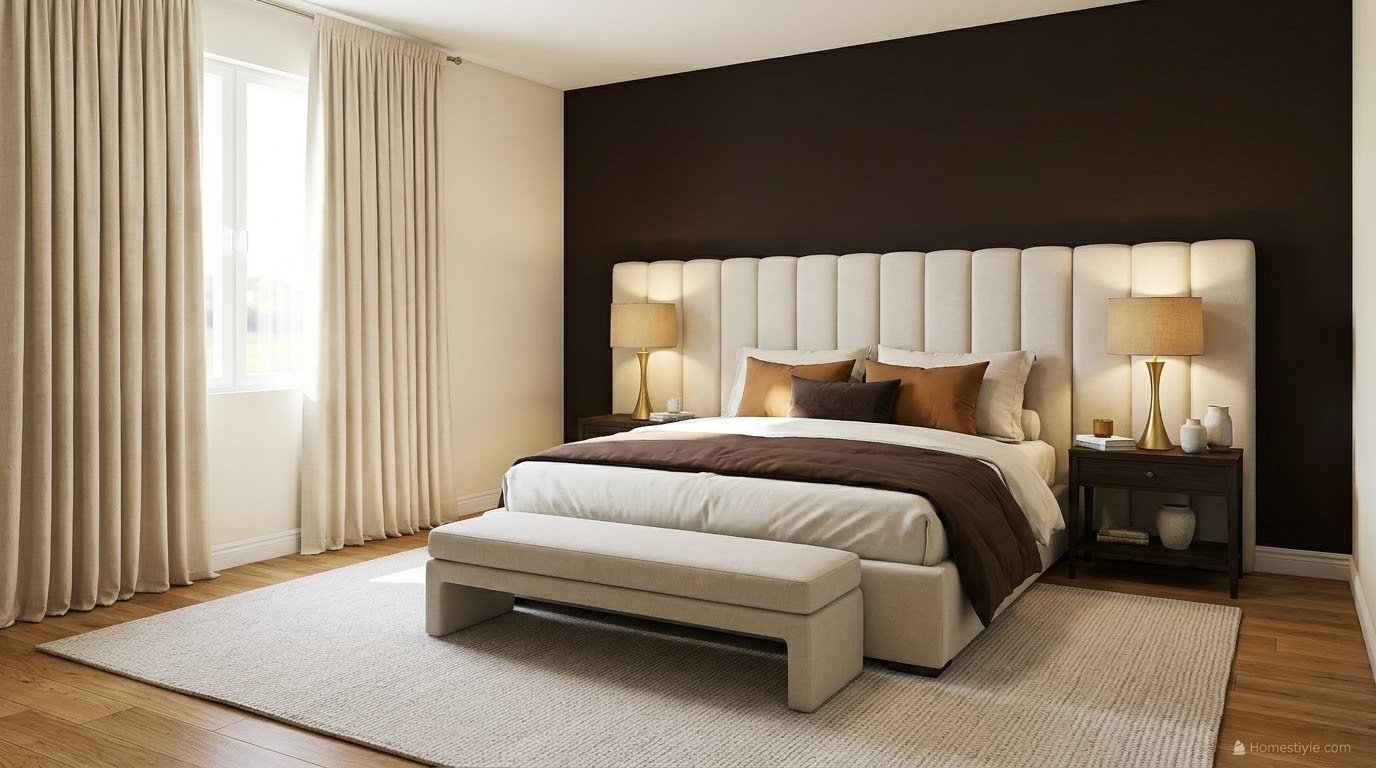
The Ladder Table
|
Shade |
Undertone |
Feels |
Pairs with |
Best surface |
|---|---|---|---|---|
|
Espresso |
Deep, near black |
Dramatic, enveloping |
Cream, brass, light blue |
Accent wall, furniture |
|
Chocolate |
Warm red |
Rich, cozy |
Cream, sage, brass |
Accent wall, bedding, headboard |
|
Mocha and cocoa |
Warm, mid |
Soft, current |
Ivory, sage, terracotta |
Walls at lower commitment |
|
Caramel and cognac |
Golden orange |
Warm, relaxed |
White, olive, rattan |
Furniture, leather, textiles |
|
Mushroom |
Gray leaning |
Quiet, versatile |
Charcoal, linen, black accents |
Walls with warm floors |
Layer at Least Three Tones
One exact shade repeated everywhere goes flat. The Home Improvement Geek chocolate brown bedroom ideas layering set makes the point: chocolate, cocoa, caramel, tan, and walnut in one room gives depth while the palette stays connected.
Three tones is the working minimum. Take the wall from one rung, the bedding from the rung above, and furniture from the wood tones you already own.
Connection matters more than count. Shades that share an undertone family read as layered; shades from different families read as mismatched.
Undertone First: Read Your Floor
Your floor votes before the paint card does. The Walls Aide brown bedroom ideas carries the warning nobody else prints: a rich chocolate wall can compete with orange toned flooring.
A cooler mushroom brown coordinates with those warm floors more comfortably. The same logic flips for cool gray floors, where chocolate’s warmth is exactly what the room needs.
Test the swatch against the floor and furniture, never against a white sample card. The undertone only shows its hand in company.
Depth Needs a Partner: The Balance Kit
Deep chocolate sits at an LRV of roughly 5 to 10. The DecorNestDaily chocolate brown bedroom ideas states the consequence plainly: those paints absorb about 90 percent of the light that hits them.
That is why the balancing layers are not optional. The wall returns almost no light, so the room’s light has to come from surfaces that do.
The kit has four parts: a cream layer, a pale rug, warm light at 2700K, and one reflective element. Run all four at any depth beyond bedding.
The Cream Layer
Cream is the lift. The pairing table in the Home Improvement Geek chocolate brown bedroom ideas gives cream the soft contrast job on bedding and curtains, and every deep room in the top guides runs on it.
Cream and ivory differ from warm white in temperature. Warm white reads sharper and more modern; cream reads softer and calmer. Both beat bright blue white, which fights brown’s warmth.
Place cream on the largest soft surface available. In most bedrooms that is the bed, which conveniently sits against the darkest wall.
The Pale Rug
The rug is the floor’s cream layer. The fall guide calls a cream, oatmeal, or light jute rug under the bed the single best tool for keeping a brown bedroom bright.
Size it by the extension rule in the DecorNestDaily chocolate brown bedroom ideas: the rug reaches about 18 inches beyond the bed, which works out to 5×8 or 6×9 for a twin, 8×10 for a queen, and 9×12 for a king.
Those sizes are one guide’s strand, stated as such. The principle underneath is universal: the pale surface must be big enough to register from the door.
Warm Light: 2700K and Three Layers
Brown turns muddy under cool light and glows under warm light. The DecorNestDaily chocolate brown bedroom ideas makes lighting the make or break layer, and the prescription is specific: 2700K warm bulbs in every fixture.
Build three layers, the same structure the Home Improvement Geek chocolate brown bedroom ideas lighting coverage teaches: soft overhead light, bedside lamps, and an accent light such as a sconce or picture light.
Cool white bulbs make brown look gray and flat. If a finished room disappoints, swap the bulbs before you touch the paint. It is the cheapest fix in this entire article.
Add dimmers where you can. A room that drops to a soft amber by bedtime is the cocoon effect, achieved with a switch instead of four brown walls.
One Reflective Element
For every dark surface, add something that reflects light. That rule comes from the cross room brown guide, and it is the balance kit in one sentence.
Brass is the natural reflector here: lamps, hardware, frames, a mirror’s edge. Its warmth matches brown’s undertone while its shine does the light work.
A mirror opposite the window is the daylight version. It bounces natural light back into a room whose walls absorb it, and it costs one hanging.
The Commitment Ladder: Bedding, One Wall, the Cocoon
Choose how deep before you choose anything else. The same ladder that orders the shades also orders the work, from reversible to permanent.
Level 1: Bedding First
The no paint level carries the whole color. The Home and Flavor brown bedding bedroom ideas owns this lane: the difference between cozy and visually heavy comes down to layering, contrast, and choosing the right brown.
Start with espresso or chocolate bedding against light walls. Crisp white or cream sheets under a deep duvet give the contrast engine that makes brown read rich.
Repeat the dark shade in only one or two smaller accents. The bedding guide is blunt about the failure mode: too many dark accessories close the room in.
This level is the renter route and the testing route. Live with it for a season; the wall decision makes itself afterward.
Level 2: One Accent Wall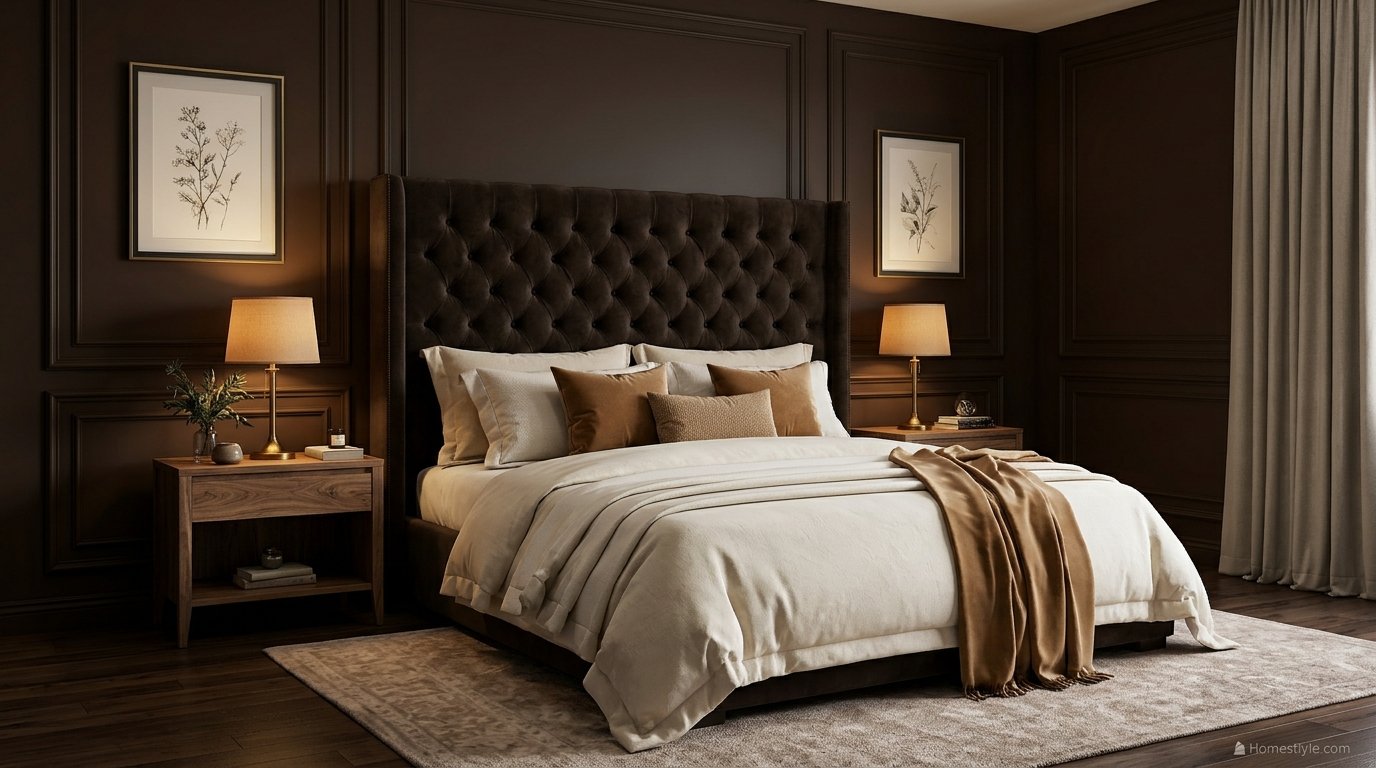
The wall behind the bed is the standard move. It creates the focal point, it frames the bed, and it leaves three walls to carry the light.
The DecorNestDaily chocolate brown bedroom ideas names the shades used for this in real rooms: Sherwin-Williams Turkish Coffee and Benjamin Moore Wenge are its examples. Verify any named shade on the brand’s own page before buying.
Keep the other walls warm white or soft cream, and the ceiling bright. The dark wall then reads as a backdrop, not a cave.
Costs at this level, from the same guide’s strands: roughly 40 to 80 dollars for paint and supplies. Treat that as one guide’s figure, not a market average.
Level 3: Four Walls or the Full Drench
The cocoon is the deepest level: walls, and in the full drench even trim and ceiling, in one warm brown.
The DecorNestDaily chocolate brown bedroom ideas gives the trick that makes it work: choose a brown with warm red undertones, not gray, then balance with cream bedding, light floors or a pale rug, and plenty of warm light.
Its cost strand for a standard bedroom runs about 120 to 200 dollars in paint. The paint is the cheap part; the balance kit is the real commitment.
The Small Room Cocoon Question, Answered Honestly
Two top guides disagree on this, and both are quoted here. One argues small bedrooms suit the full cocoon best, because enveloping color blurs corners and turns a box into a retreat.
The 10Fantastic brown bedroom ideas warns the other way: dark brown on all four walls can make a small room feel smaller, especially with little natural light, and recommends soft mocha, a single accent wall, or brown furniture instead.
The reconciling rule is conditions, not room size. The cocoon works when the bed stays pale, the ceiling stays bright, and the light is warm and layered. Skip any of those, and the caution wins.
The Bed Stays Light: Bedding Builds
Against a dark wall, the bed is the balance. It is the largest pale surface in the room, and it sits exactly where the eye lands.
The Three Tone Build
Build the bed in three browns plus a lift. The DecorNestDaily chocolate brown bedroom ideas palette runs: a chocolate duvet or coverlet as the base, caramel or rust as the middle layer, and cream sheets and shams as the lift.
The Evyve Homes chocolate brown bedroom ideas hotel trick deepens it: layer two standard shams behind two euros in a tonal shift, cream to terracotta, for expensive looking depth without clutter.
Keep bedding to those tones and let texture vary instead. Washed linen, velvet, chunky knit, and cotton in the same palette beat a fourth color every time.
Texture Over Pattern
In dark rooms, texture does pattern’s job. Pattern contrast flattens at low light; texture contrast survives because it works through shadow, not color difference.
A velvet headboard is the lead texture for a reason. The Lost at e Minor chocolate brown bedroom ideas notes how velvet captures light into shifting cocoa and espresso tones, so one piece displays the whole ladder.
Washed linen bedding adds the relaxed version of the same effect: color delivered through a soft, rumpled surface rather than a flat one.
Headboard Scale
The headboard puts brown at the room’s visual center. A tall upholstered headboard in cocoa or espresso velvet adds the color plus a softness painted walls cannot give.
Scale it to the room first. One guide’s caution: oversized headboards overwhelm rooms under 12 feet wide. Measure the wall, then shop.
The DecorNestDaily chocolate brown bedroom ideas cost strand for a velvet headboard runs roughly 180 to 450 dollars, labeled as its figure. Wingback and channel tufted shapes are its suggested forms for medium rooms.
Pairings by Job: Lift, Soften, Cool, Deepen, Shine
Pair by the job, not by the color wheel. Every partner color in the top guides is doing one of five jobs. Name the job your room needs and the pairing chooses itself.
The pairing table in the Home Improvement Geek chocolate brown bedroom ideas is the cleanest version: cream for soft contrast, beige for tonal warmth, sage for earthy contrast, dusty blue for cool balance, burgundy for deeper mood, brass for warm highlight.
Lift: Cream and Warm White
Lift is the default job. Cream on bedding and curtains, warm white on walls and bedding, both against chocolate on the wall or the bed frame.
Warm white makes chocolate look sharper and more modern. Cream makes it look calmer and more classic. The room’s other materials decide which lift to run.
Soften: Beige and Caramel
Beige creates a gentler transition than white. It suits rooms that should feel calm rather than high contrast, on rugs, curtains, upholstery, and larger bedding pieces.
Caramel softens from inside the family. A caramel throw across the foot of the bed ties bedding back to brown walls without matching them exactly, a move the small room guide in the 10Fantastic brown bedroom ideas uses.
Ground: Sage and Olive
Muted green gives brown an earthy direction. Sage is the softer choice on pillows and textiles; olive creates a deeper, moodier palette.
This is the nature pairing, and it forgives mixed wood tones better than any other. Rooms with plants and rattan land here naturally.
On the cooler side of the bedroom shelf, the Mint green bedroom ideas shows green running a whole room on its own. Brown and green together split the difference: green cools the accents, brown warms the base.
Cool: Dusty Blue, Navy, Slate
Blue is brown’s contrast color. Dusty blue cools on throws and artwork; navy runs deeper; slate blue carries an upholstered bed or curtains against chocolate walls, per the Walls Aide brown bedroom ideas pairing.
Blue can chill a room if the light runs cool too. Keep the bulbs warm and the blue earns its place.
The Sky blue bedroom ideas runs blue as a full room color. In a brown room it works better as the controlled accent, because brown owns the warmth and blue spends it carefully.
Deepen and Shine: Burgundy and Brass
Burgundy deepens in small doses only. It is the pairing table’s mood accent: pillows, a lumbar cushion, one ceramic. Large burgundy surfaces push an already deep room toward heavy.
Brass shines. Lamps and hardware in brass or aged gold are the polished note in the pairing table, and they double as the balance kit’s reflective element.
Finishes, Testing, and the Paint Decision
Finish changes what the color does. The same chocolate in matte and satin is two different rooms.
Matte, Eggshell, Satin
Matte hides small wall imperfections and gives a soft, flat depth. It is the finish the small room guides reach for first in bedrooms.
Satin reflects a little more light and wipes clean more easily, which helps where hands and shoulders brush walls. The trade: more glare, more visible flaws.
Eggshell sits between them and is the usual bedroom default. For most rooms the ladder matters more than the sheen; pick the shade family first.
The Swatch Protocol
Brown shifts more than most colors. The 10Fantastic brown bedroom ideas protocol is the standard: paint a large swatch and look at it morning and evening before committing.
The SheKnows Style brown bedroom ideas adds the second wall: test on different walls, because the wall behind the bed and the window wall will not agree about the same paint.
Check the swatch against the floor, the bedding, and the wood furniture, at lamplight as well as daylight. Four checks, one gallon saved.
Named Shades, Handled Carefully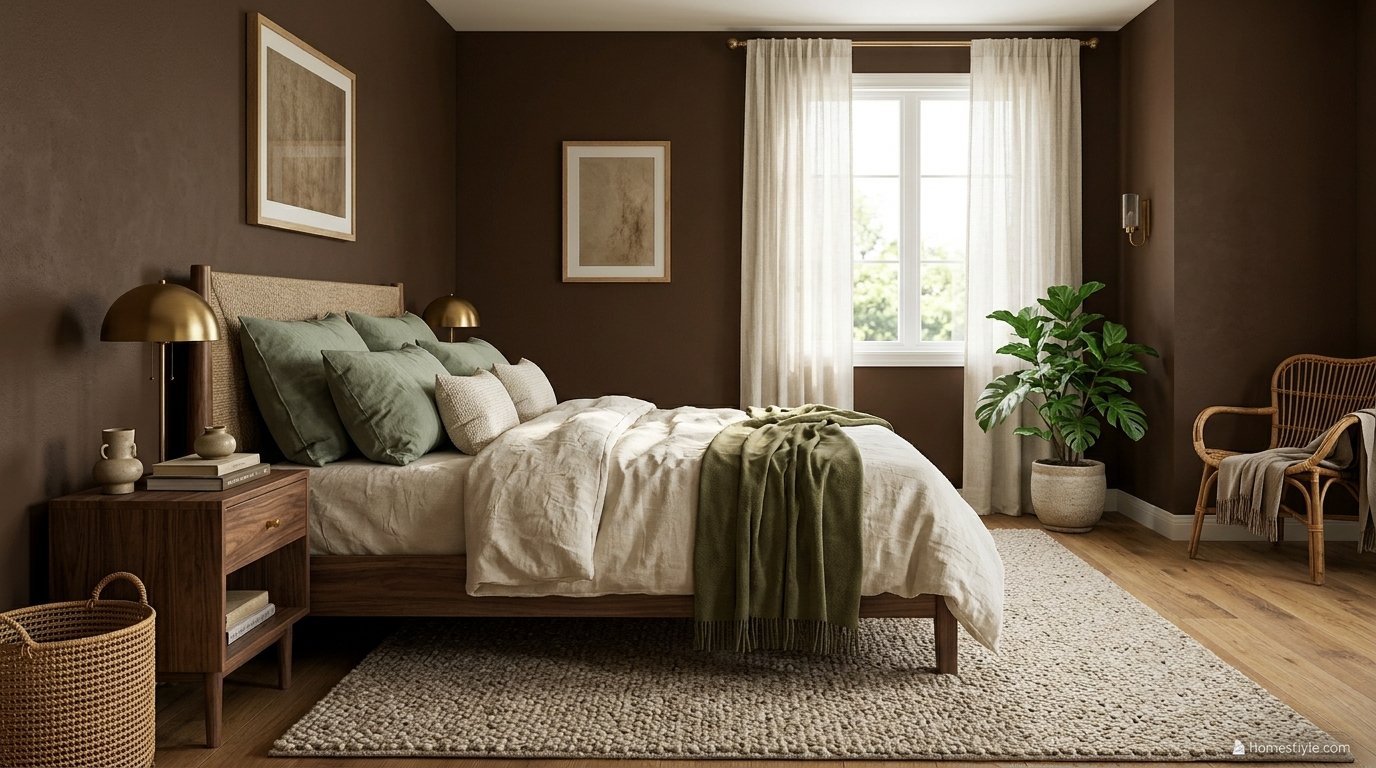
Named shades in this article are leads, not gospel. Beyond Turkish Coffee and Wenge, the Evyve Homes chocolate brown bedroom ideas rooms name Sherwin-Williams Hot Cocoa SW 6046 and Farrow and Ball London Clay 244 among their schemes.
Paint names and codes get checked on the brand’s own color page at buying time, including the LRV the brand publishes. That check is part of the method, not a footnote.
The trend anchor above all of them: Pantone named Mocha Mousse, a soft chocolate brown, its Color of the Year for 2025, a fact the brown guides cite as the moment brown replaced gray as the warm neutral of record.
When Brown Goes Wrong: The Diagnosis Table
Most brown failures have a name and a fix. Diagnose before you repaint; half of these are light problems wearing a paint costume.
|
Symptom |
Likely cause |
Fix |
|---|---|---|
|
Room reads as a cave |
Deep walls, no pale surface |
Cream bedding, pale rug, bright ceiling |
|
Brown looks gray and flat |
Cool white bulbs, or a gray leaning shade |
2700K bulbs first; a redder chocolate second |
|
Brown looks muddy |
Too little light for the LRV |
Add light layers and one reflector |
|
Wall fights the floor |
Reddish chocolate over orange toned wood |
Switch the wall rung to mushroom |
|
Room feels heavy, not cozy |
Dark accents repeated everywhere |
Dark repeats limited to one or two accents |
|
Bed disappears into the wall |
Dark bedding against dark walls |
Rebuild the bed pale with a chocolate layer only |
The Gray Problem
Gray looking brown is the most common complaint. Two causes stack: a shade whose undertone leans gray, and light that leans cool.
Fix the light first because it is reversible. If 2700K bulbs do not restore the warmth, the shade itself is wrong, and the fix is a redder rung, not a lighter one.
The Heavy Problem
Heavy means a balance part is missing. Audit in kit order: one large pale surface, warm layered light, one reflector, dark accents limited.
Add the missing part and stop when the room lifts. The most common single fix across the guides is the pale rug.
Room Cases
The method bends by room. Four cases cover most of the searches behind this keyword.
Small Bedrooms
Small rooms take the ladder’s lighter rungs or one deep move. Soft mocha walls, a single chocolate accent wall, or chocolate bedding against pale walls.
Keep furniture low and light in tone. The 10Fantastic brown bedroom ideas adds that brown hides everyday wear better than white, a practical point small busy rooms appreciate.
The walnut slat wall from the SheKnows Style brown bedroom ideas list is the elegant small room feature: warmth and texture behind the bed without darkening the whole room.
Low Light and North Facing Rooms
Discipline replaces depth. Prefer the accent wall or the bedding level, keep the ceiling bright, and hold every bulb at full warmth.
Add the mirror opposite the window. In a room whose walls absorb 90 percent of light, bounced daylight is not a trick; it is a supply line.
Rentals
Rentals climb only to level one, and level one is enough. Bedding, curtains, a pale rug, and warm lamps deliver the full palette with zero paint.
The Home and Flavor brown bedding bedroom ideas bedding lane was written for exactly this constraint. When the lease ends, the bedroom leaves in boxes and the deposit stays intact.
Primary Suites
Suites can carry the drench. More walls, more light sources, and a seating corner give the deep version room to breathe.
Layer the suite in zones: deepest at the bed wall, mid tones at the seating, cream at the windows. The ladder becomes the floor plan.
Frequently Asked Questions
1. Is chocolate brown a good color for a bedroom?
Yes, when it is balanced.
Brown feels calm and grounding in a room built for rest, and chocolate behind the bed makes a cozy backdrop.
The condition every guide repeats: cream bedding, warm layered light, and at least one pale or reflective surface pushing back against the depth.
2. What colors go best with chocolate brown in a bedroom?
Cream and warm white lift it, beige softens it tonally, sage and olive ground it in nature, dusty blue and navy cool it, burgundy deepens it, and brass makes it glow.
Choose by the job your room needs: lift, soften, ground, cool, deepen, or shine.
3. What color bedding looks best with chocolate brown walls?
Cream or ivory is the consensus answer, because the bed is the largest pale surface in the room and it sits against the darkest wall.
Build the bed in three tones: a chocolate base, a caramel or rust middle, and cream sheets and shams as the lift.
4. Will dark brown walls make my bedroom look smaller?
The guides disagree, and light decides.
One warns that four dark walls can shrink a small, low light room.
Another argues small rooms suit the cocoon best because the color blurs corners.
Pale bedding, a bright ceiling, and warm layered light are the conditions that make the cocoon version work.
5. Should I paint all four walls chocolate brown?
Only with the full balance kit in place: a warm red undertone paint rather than a gray leaning one, cream bedding, a pale rug or light floors, warm 2700K light in layers, and one reflective element.
Without those, one accent wall behind the bed delivers most of the effect at a fraction of the risk.
6. What is the best brown paint color for a bedroom?
For depth, guides name Sherwin-Williams Turkish Coffee and Benjamin Moore Wenge on accent walls, and Sherwin-Williams Hot Cocoa SW 6046 inside room schemes.
For a softer room, mocha and cocoa shades carry the warmth at half the darkness.
Verify any shade and its LRV on the brand page before buying.
7. What is the difference between chocolate, espresso, mocha, and caramel brown?
Chocolate is warm with a reddish quality.
Espresso runs deeper, approaching near black.
Mocha and cocoa sit mid ladder, soft and warm.
Caramel and cognac lean golden and orange.
Mushroom leaves the warm family toward gray and taupe, which is why it coordinates where chocolate clashes.
8. Why does my chocolate brown paint look gray?
Two causes usually stack: the paint leans gray in its undertone, or the room’s light is cool.
Cool white bulbs make brown read gray and flat.
Test warm 2700K bulbs first; if the brown still grays, the shade itself is wrong and a redder chocolate fixes it.
9. Why does my brown bedroom look muddy?
Muddy is a light problem before it is a color problem.
Deep chocolate at an LRV of roughly 5 to 10 absorbs about 90 percent of light, so underlit brown collapses into mud.
Warm bulbs, a second and third light layer, and one reflective surface restore the richness.
10. What lighting works best in a chocolate brown bedroom?
Warm 2700K bulbs in three layers: soft overhead light, bedside lamps, and an accent light such as a sconce or picture light.
Dimmers let the room drop to amber by bedtime.
Cool white light is the single most common reason finished brown rooms disappoint their owners.
11. How do I keep a brown bedroom from feeling heavy?
Run the balance checklist in order: one pale large surface in the bedding or the rug, warm layered light, one reflector such as brass or a mirror.
And the dark shade repeated in only one or two small accents beyond the main surface.
Heavy almost always means one part is missing.
12. Which brown works with orange wood floors?
A reddish chocolate can compete with orange toned flooring, per the undertone guide.
A cooler mushroom brown coordinates with warm orange floors more comfortably, and caramel can fight them too.
Test the swatch against the floor itself, never against a white sample card.
13. How many shades of brown can I use in one bedroom?
Three tones is the working minimum for depth, and the ladder gives five to draw from.
One guide’s layering set runs chocolate, cocoa, caramel, tan, and walnut.
The rule is connection over count: shades sharing an undertone family read as layered, while mixed families read as mismatched.
14. Can I do a chocolate brown bedroom without painting?
Yes, and it is the best first step.
The bedding lane carries the whole color: a chocolate duvet over cream sheets, natural wood furniture, the dark shade repeated in one or two accents, and warm lamps.
Renters and the undecided should start here and live with it for a season.
15. What finish is best for chocolate brown walls: matte, eggshell, or satin?
Matte hides small wall flaws and gives soft, flat depth.
Eggshell is slightly easier to wipe clean and is the usual bedroom default.
Satin reflects more light and wipes cleanest, which helps where hands brush walls, at the cost of more glare and more visible flaws.
16. Should the ceiling be painted in a brown bedroom?
Accent wall guides keep the ceiling bright white to hold the height.
Drench guides paint it with the walls for the full cocoon.
Decide by height and light: low or dim rooms keep the bright ceiling, while the cocoon suits rooms where enveloping is the whole goal.
17. How big should the rug be in a dark brown bedroom?
One guide’s extension rule puts the rug about 18 inches beyond the bed on the sides: 5×8 or 6×9 for a twin, 8×10 for a queen, and 9×12 for a king.
In a brown room the rug also does color duty, so choose cream, oatmeal, or pale jute.
18. Does a pale rug really brighten a brown bedroom?
One fall guide calls a cream, oatmeal, or light jute rug under the bed the single best tool for keeping a brown bedroom bright.
It is the largest pale horizontal surface in most rooms, and it sits exactly where the eye lands from the doorway.
19. What metals go with chocolate brown?
Brass and aged gold are the consensus warm metals, on lamps, hardware, frames, and mirror edges.
Their warmth matches brown’s undertone, and their shine supplies the reflective element deep paint cannot.
Chrome and bright silver cool the palette and fight the mood in most schemes.
20. Chocolate brown and sage green: does it work?
It is one of the classic pairings in this topic.
Sage is the softer, lighter choice; olive runs deeper and moodier.
Green gives brown an earthy direction, it works on pillows and textiles first, and it suits rooms with plants and natural wood around them.
21. Chocolate brown and blue: which blue?
Dusty blue gives a cool balance on throws and artwork.
Navy runs deeper and more formal.
Slate blue can carry an upholstered bed or curtains against chocolate walls.
Blue cools brown, so keep the lighting warm to stop the room from chilling.
22. How do I add chocolate brown to a small bedroom?
Use the ladder’s lighter rungs and one commitment: soft mocha walls, a single chocolate accent wall behind the bed, or chocolate bedding against pale walls.
Keep furniture low and light in tone, keep the bed pale, and test a large swatch morning and evening before deciding.
23. What size headboard suits a brown bedroom?
A tall upholstered headboard in cocoa or espresso velvet puts the brown at the room’s visual center, with a softness paint cannot give.
One guide cautions that oversized headboards overwhelm rooms under 12 feet wide, so scale the headboard to the room’s width before shopping.
24. Velvet, linen, or leather: which texture leads a brown bedroom?
Velvet leads for drama and light play, shifting between cocoa and espresso tones as light moves.
Washed linen leads for relaxed, approachable rooms.
Caramel leather leads for mid century character.
In dark rooms texture does the work pattern does elsewhere, because pattern contrast dies at low light.
25. How do I layer brown bedding?
Build three tones across the bed: a chocolate duvet or coverlet as the base, caramel or rust as the middle layer, and cream sheets and shams as the lift.
Add depth with shams in a tonal shift, and vary texture across linen, velvet, and knit instead of adding pattern.
26. What curtains work in a chocolate brown bedroom?
Caramel linen brings warmth that still filters light.
Pale curtains serve dark walled rooms where daylight needs help.
A layered option from the idea lists pairs floor length brown curtains with sheer white panels behind them, giving privacy and daylight at the same time.
27. Is brown a dated bedroom color?
The guides say the reputation has flipped.
Brown is positioned as the warm, grounding alternative to cool gray, Pantone named the soft chocolate Mocha Mousse its 2025 Color of the Year, and one fall guide calls brown the defining interior color of fall 2026.
Dated brown was flat and matched; current brown is layered and textured.
28. What is color drenching in a brown bedroom?
Color drenching paints walls, trim, and even the ceiling in the same chocolate, so the room wraps like a cocoon and corners blur.
One guide recommends it especially for small bedrooms.
It demands the full balance kit: cream bedding, brass lamps, and warm layered light throughout.
29. How do I test a brown paint before committing?
Paint a large swatch and check it morning and evening, on more than one wall if you can.
Browns shift more than most colors between daylight and lamplight, and the undertone only shows against your floor and furniture.
Look at both ends of the day before buying gallons.
30. Can chocolate brown work in a north facing, low light bedroom?
Yes, with discipline.
Prefer the accent wall or the ladder’s lighter rungs, keep the ceiling bright, run 2700K bulbs at full warmth, add a mirror opposite the window to bounce daylight, and keep the bed and rug pale.
A four wall drench in a dim north room is the version guides consistently caution against.
31. What wood tones work with chocolate brown walls?
Natural wood is brown’s easiest partner: walnut for tonal depth, oak for lightness, cane and rattan for texture.
Dark wood furniture grounds a pale walled brown scheme, while light wood furniture lifts a dark walled one.
Mixed wood tones stay forgiving here as long as undertones stay warm.
32. How do I make a brown bedroom feel luxurious?
The luxury kit from the guides: velvet at the headboard, brass at the lamps, a layered bed in three tones with hotel depth shams, and one deep pairing like burgundy kept to small accents.
Luxury in a brown room is texture and metal, not more darkness.
33. What do I do if my brown bedroom still feels heavy after decorating?
Audit the balance kit in order: one large pale surface, every bulb warm, one reflector present, dark accents limited to one or two repeats.
Add the missing part and stop when the room lifts.
Across the guides, the most common single fix is the pale rug.
34. Chocolate brown or espresso: which for an accent wall?
Chocolate gives warmth and a clear focal point.
Espresso gives near black drama with brown’s softness, and it pairs with cream, brass, and even light blue.
In a low light room, chocolate is the safer of the two because it returns a little more warmth to the eye.
35. Does brown bedding need brown walls?
No, and the bedding lane proves the reverse works better for most rooms: chocolate bedding against white or light beige walls gives strong contrast and keeps the room bright.
Brown on brown is the monochromatic build, which needs shade and texture variation to avoid going flat.
36. How do I transition a gray bedroom to brown?
Work the warm layer in gradually: caramel or rust textiles first, a walnut piece second, warm bulbs third, and the paint decision last.
Mushroom brown can coexist with gray during the transition because it leans gray itself.
The guides frame brown as gray’s warm successor, so most furniture survives the change.
37. What patterns work in a chocolate brown bedroom?
Use pattern sparingly and at small scale: a patterned rug, one printed cushion, or chocolate wallpaper on a single wall.
At low light, large pattern contrast flattens out.
The guides consistently build interest from texture layering instead, which keeps working after dark.
38. How much does a chocolate brown bedroom cost?
Only one guide publishes per idea costs, so these are its strands, never averages: an accent wall at 40 to 80 dollars, a velvet headboard at 180 to 450, a four wall cocoon at 120 to 200.
Lighting at 30 to 150, bedding pieces at 60 to 200, and fall accents at 20 to 60.
Your ladder level sets your spend.
39. Is a chocolate brown bedroom good for sleep?
One cocoon guide argues the deepest version is the most restful sleep space brown can offer, because enveloping dark walls lower visual stimulation.
That is one guide’s position, stated as a strand.
The shared ground across all of them: brown rooms feel calm and grounding, which suits a room meant for rest.
40. What is the fall 2026 brown bedroom trend?
One guide frames brown as the defining interior color of fall 2026 and builds a fall retreat version: chocolate walls or bedding, rust and amber accents, caramel linen, and warm layered light.
The durable content underneath the season is the system itself: the ladder, the balance kit, and the commitment level.
41. Can I use chocolate brown in a guest bedroom?
Yes, at the middle commitment level.
An accent wall or rich bedding, cream layers, and warm lamps make a guest room feel designed rather than defaulted.
Keep one light element obvious, a pale rug or white bedding, so the room reads welcoming at first sight, day or night.
42. How do I warm up a brown bedroom for winter?
Deepen the existing ladder rather than changing it.
Swap the middle bedding layer to rust or burgundy, add a chunky knit or wool throw, raise lamp warmth with amber shades, and layer a heavier curtain.
The brown base stays in place; only the seasonal layer rotates.
Conclusion
Chocolate brown bedroom ideas stop being risky once the color gets its system. The ladder names the shade, the undertone check protects it, and the balance kit keeps it glowing.
Pick the rung first: espresso for drama, chocolate for the classic warm room, mocha for softness, caramel for light, mushroom for tricky floors.
Then climb only as high as the room earns: bedding, one wall, the cocoon. Each level works on its own, and each one teaches you the next.
Run the kit at every level: cream on the biggest soft surface, a pale rug under the bed, 2700K light in three layers, and one piece of brass or mirror doing reflector duty.
Diagnose before you repaint. Gray, muddy, and heavy are light and undertone problems far more often than they are paint problems.
The Homestiyle bedroom shelf covers the rest of the color wheel when brown has done its work. Start at level one this week, and let the room itself argue for level two.
