
A long narrow basement can feel more like a hallway than a living area — but only if you leave it unplanned. The right layout strategy turns that tunnel-shaped room into one of the most functional spaces in your entire home. Whether you want a cozy lounge, a kids play corner, a mini bar, or a mix of all three, this guide walks you through practical, design-forward ideas that actually work in tight footprints.
No wasted square footage. No cramped feeling. Just smart choices that stretch the space visually and physically.
Use an L-Shaped Sectional as a Divider
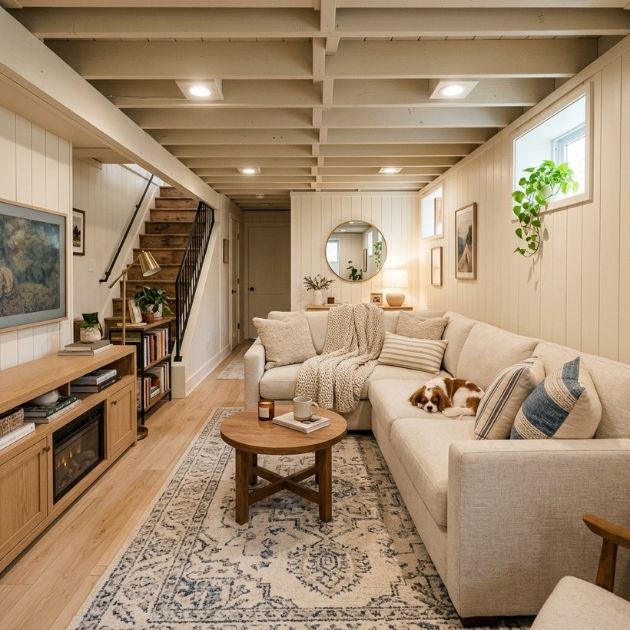
One of the simplest upgrades you can make in a long narrow basement is swapping a straight sofa for an L-shaped sectional. The angled configuration creates a soft visual boundary between your lounge and whatever comes next, without building a wall or blocking sightlines.
Position the longer arm of the sectional parallel to the wall. The short arm juts inward and signals “seating zone ends here.” It is a layout trick that works in finished basements of all sizes, and it immediately makes the space feel intentional rather than stretched.
A few choices to try:
- Cream or warm linen sectional — keeps the room feeling light and open
- Textured throw pillows in earthy tones — warm up the cool basement atmosphere
- Neutral striped area rug beneath the sofa — locks the zone in place without visual clutter
Break It Into Zones First
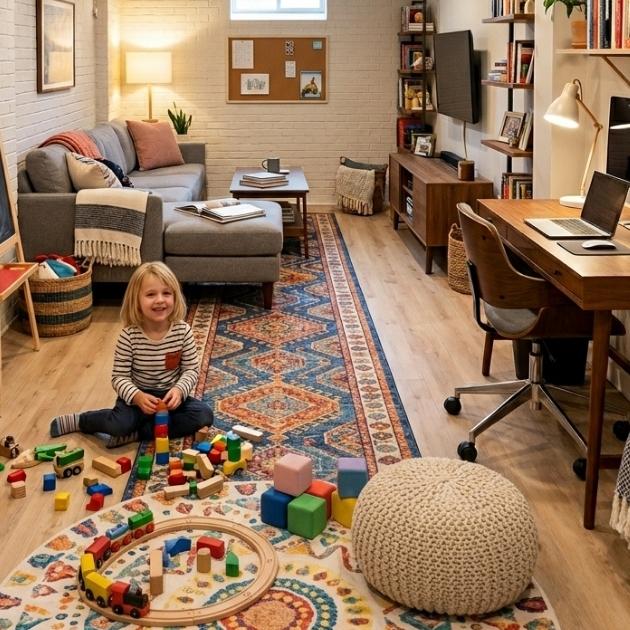
Before buying a single piece of furniture, map out your zones. This is the step most homeowners skip, and it is also the reason narrow basements feel chaotic. Think of your basement as a series of distinct rooms — each one defined by purpose, lighting, and floor treatment rather than walls.
Common zone combinations that work well in narrow layouts include:
- Media lounge + casual game area
- Kids play corner + adult seating
- Home office + workout space
- Bar area + lounge
Once your zones are on paper, the furniture decisions become much easier.
A few things you might like:
- Long runner rug — visually defines walking paths between zones
- Open shelf room divider — creates separation without blocking airflow
- Slim console table — anchors a zone transition point without bulk
Anchor One End With a Media Wall
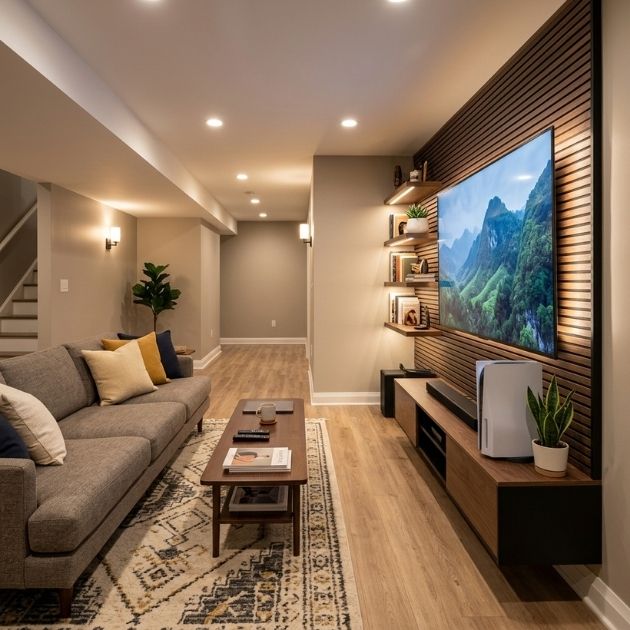
A media wall at one short end of the basement gives your eye a destination. That single move eliminates the tunnel effect immediately. Mount the screen flush to the wall, use a shallow floating media console beneath it, and frame the whole setup with vertical shelving on either side for storage and visual balance.
The key is keeping everything slim. A deep entertainment center eats into the walkway and makes the space feel narrower than it actually is. Floating units and wall-mounted screens are your best friends in this layout.
These products might be useful:
- Wall-mounted TV bracket with cable management — keeps the setup clean and flush
- Floating media console (under 12 inches deep) — preserves precious floor width
- LED strip lighting behind the screen — adds depth and reduces eye strain during movie nights
Define the Lounge With One Big Rug
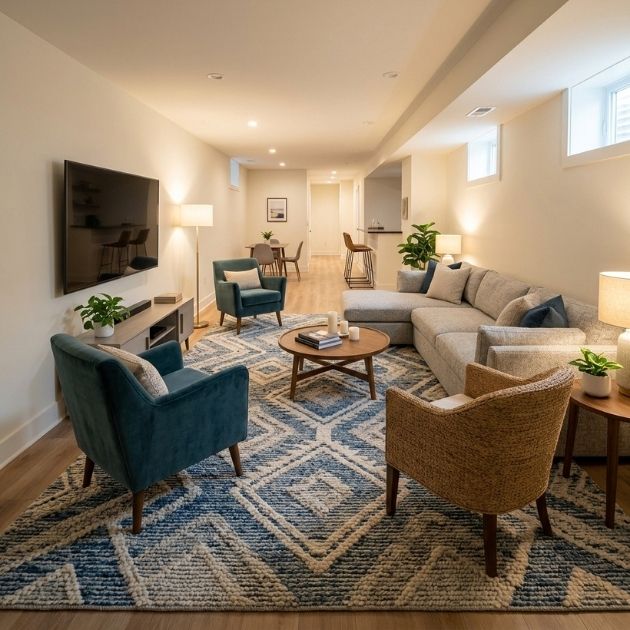
Resist the urge to use a small rug because it feels like the “safe” choice for a tight space. In a long narrow basement, an undersized rug actually makes the room look more compressed. One large area rug that sits beneath all four legs of your seating set anchors the zone, defines the lounge boundary, and makes the whole layout feel cohesive.
Go for a rug that extends at least 6 inches past each side of your sofa. Low-pile rugs in light neutrals or subtle patterns work especially well because they do not compete with the other design elements in a busy multi-zone basement.
Possibly helpful picks:
- Geometric low-pile area rug in beige or grey — elongates without overpowering
- Runner rug for the main walkway — visually separates traffic flow from seating zones
- Anti-slip rug pad — essential on any smooth basement flooring
Run a Storage Spine Along One Wall
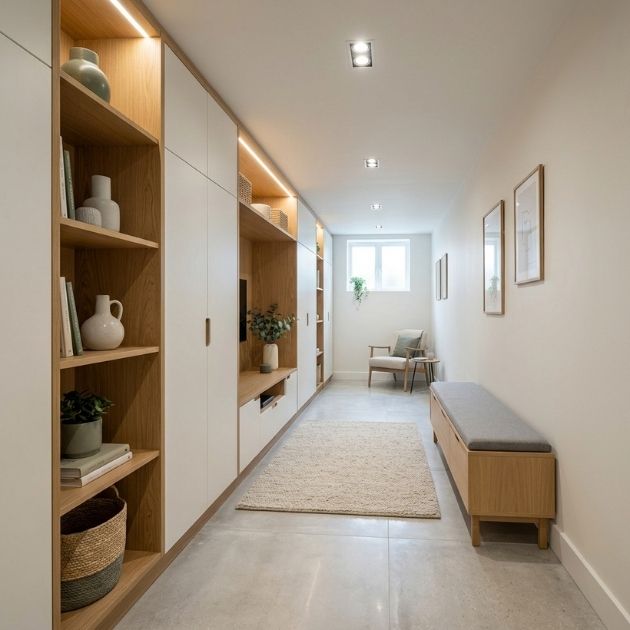
Pick one long wall and commit it entirely to storage. Built-in cabinetry, open shelving, or a combination of both — when storage runs the full length of a single wall, the opposite side stays open and the room reads as wider than it is.
This “storage spine” approach also solves the clutter problem that plagues most basements. Everything has a home, pathways stay clear, and the space looks intentional from the moment you walk downstairs.
Maybe worth checking out:
- Modular wall-mounted shelving system — flexible, adjustable, and budget-friendly
- Built-in cabinets with closed lower doors — hide the messy stuff, display the nice stuff
- Floating wall shelves in matching wood tone — creates visual continuity across the entire wall
Keep Walkways Clear With Slim Furniture
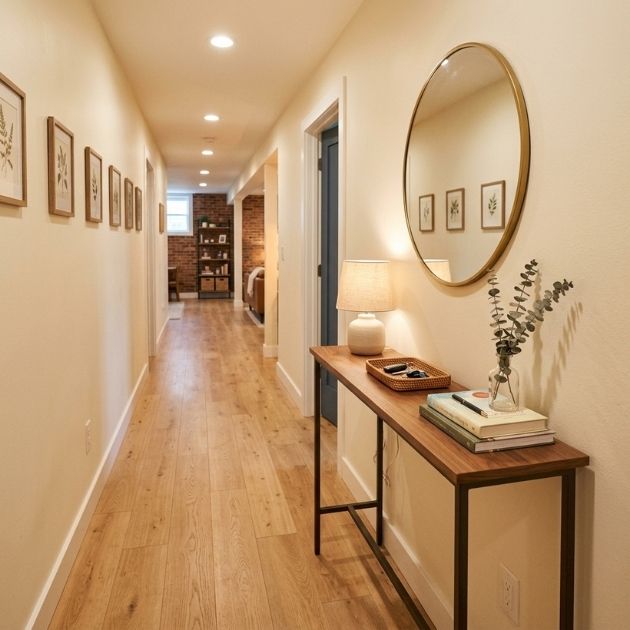
Wide furniture is the fastest way to make a narrow basement feel suffocating. Swap bulky pieces for slim-profile options wherever possible. A narrow sofa table behind the sectional, wall-hung side tables, and backless stools at a bar counter all serve their function without eating into the walkway.
The general rule of thumb: maintain at least 36 inches of clear walkway at all times. In a basement that is 10 to 12 feet wide, that means every furniture choice matters.
These products might help:
- Narrow console table (under 14 inches deep) — useful behind the sofa without crowding
- Wall-mounted fold-down desk — eliminates the need for a full desk footprint
- Backless counter stools — slide fully under the counter when not in use
Light It Evenly With Recessed Lighting
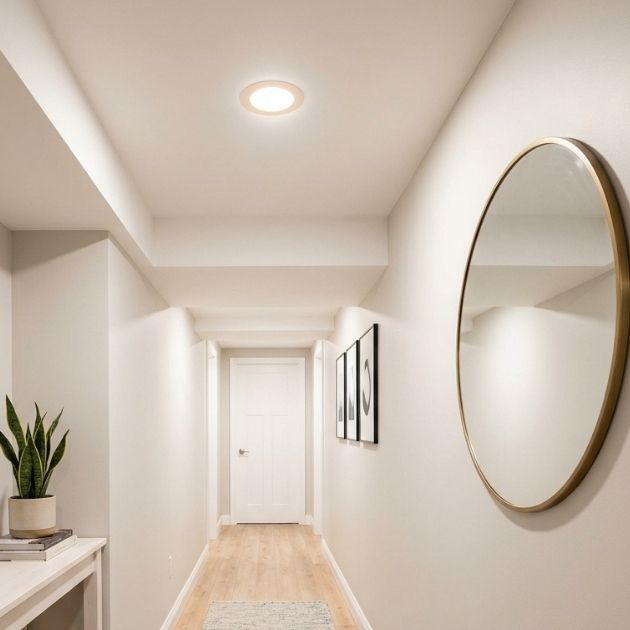
Poor lighting is the number one reason narrow basements feel claustrophobic. A single overhead light leaves dark corners and exaggerates the tunnel shape. Recessed can lighting, spaced evenly in a grid pattern across the ceiling, distributes light throughout the space and eliminates heavy shadows along the walls.
Add dimmable fixtures so you can adjust the ambiance for different zones, brighter light over the game table, warmer tones over the lounge seating. Layered lighting with recessed fixtures, floor lamps, and task lights creates depth that flat overhead lighting simply cannot replicate.
Items that may come in handy:
- Dimmable LED recessed light kit — flexible brightness for every activity
- Plug-in wall sconces — add warmth along the walls without new wiring
- Under-shelf LED strip lights — highlight storage and add ambient glow
Use One Continuous Floor to Stretch the Space
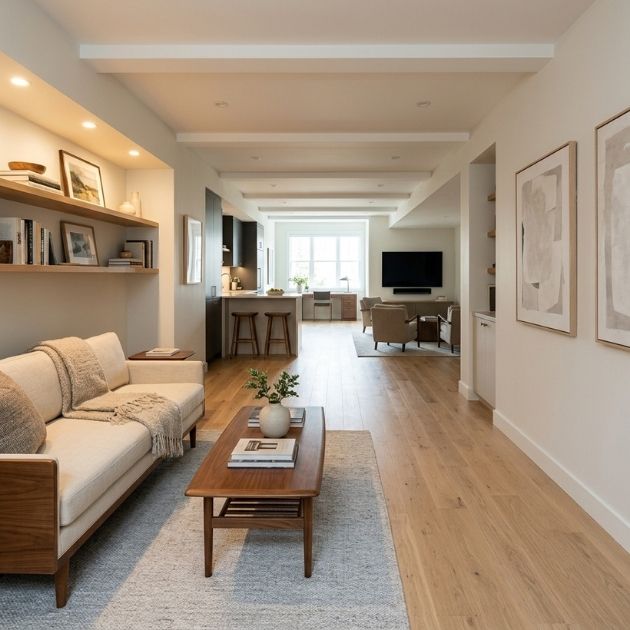
Switching floor materials midway through a narrow basement, say, carpet in the lounge and vinyl in the game area, chops the visual flow and makes both zones feel smaller. A single continuous flooring material across the entire length of the basement allows the eye to travel uninterrupted, making the room feel longer and wider simultaneously.
Wide plank luxury vinyl or engineered hardwood in a light to medium tone works exceptionally well. Avoid dark or very high-contrast floors in a narrow space, as they emphasize the width constraint rather than disguise it.
Some ideas to consider:
- Wide plank engineered white oak flooring — creates visual length and warmth
- Luxury vinyl plank (LVP) in a light wood tone — water-resistant and durable for basements
- Self-adhesive floor planks — a budget-friendly way to test continuous flooring before committing
Make the Under-Stairs Area Work Harder
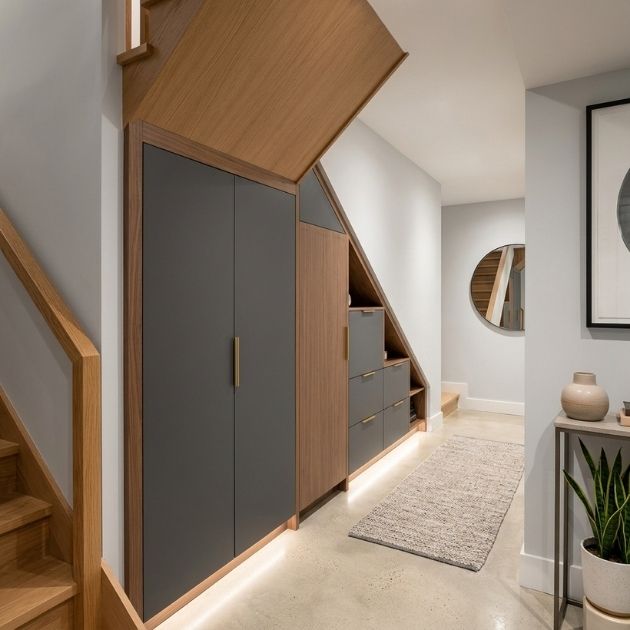
That triangular nook beneath the staircase is some of the most underused real estate in any basement. Depending on its size and your needs, it can become a closed storage cabinet, an open display shelf, a compact bar nook, a reading bench, or even a small home office alcove.
Custom built-ins are the cleanest solution, but prefabricated units that fit the opening work just as well for most homeowners. Adding a light inside the nook makes it look finished and intentional rather than like an afterthought.
Might be a good match:
- Custom-fit under-stair storage drawers — maximize every inch of that awkward triangle
- Small upholstered bench with cubby storage below — creates a functional sitting spot
- Compact floating shelves — display books or decor inside the nook without blocking the stairs
Add a Slim Bar at One End
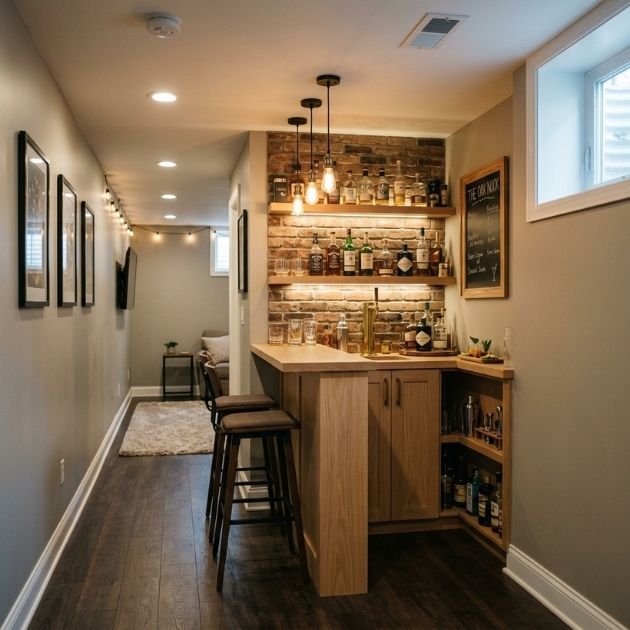
A slim wet bar or dry bar tucked against the far short wall gives the basement a clear focal point and a reason to walk the full length of the room. Even a wall-mounted shelf with a small wine fridge and a couple of bar stools can feel like a complete bar setup in a narrow space.
Keep the bar footprint shallow, 18 to 24 inches deep is usually sufficient. Wall-mounted bottle holders and glassware racks free up counter space and add visual interest without requiring additional square footage.
Check these products out:
- Compact under-counter wine fridge — fits beneath a standard countertop shelf
- Wall-mounted bottle rack — stores wine vertically and looks great doing it
- Backless bar stools (counter height) — save space and tuck neatly under the counter
Place a Game Table Behind the Seating
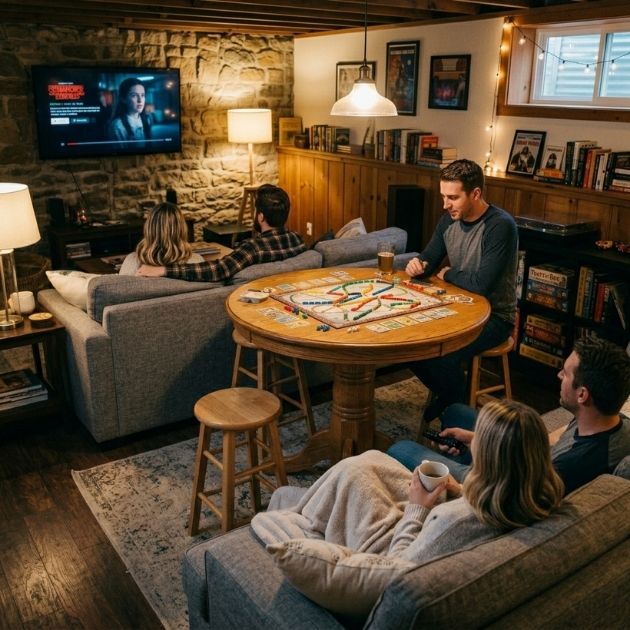
Once your lounge zone is anchored, use the remaining length of the basement for activity. A game table — whether that is a compact foosball table, a poker table, a shuffleboard, or even a small billiards setup — placed directly behind the sofa section creates a natural flow from passive to active entertainment.
Choose foldable or multi-game tables if the space is especially tight. Many modern game tables double as dining tables, which adds a practical layer to the basement without requiring extra furniture.
A few helpful options:
- Multi-game table (convertible top) — ping pong, pool, or air hockey in one footprint
- Foldable poker table with chairs — stores away when not hosting game nights
- Wall-mounted dart board with scoreboard — takes no floor space at all
Use a Daybed for a Guest-Friendly Zone
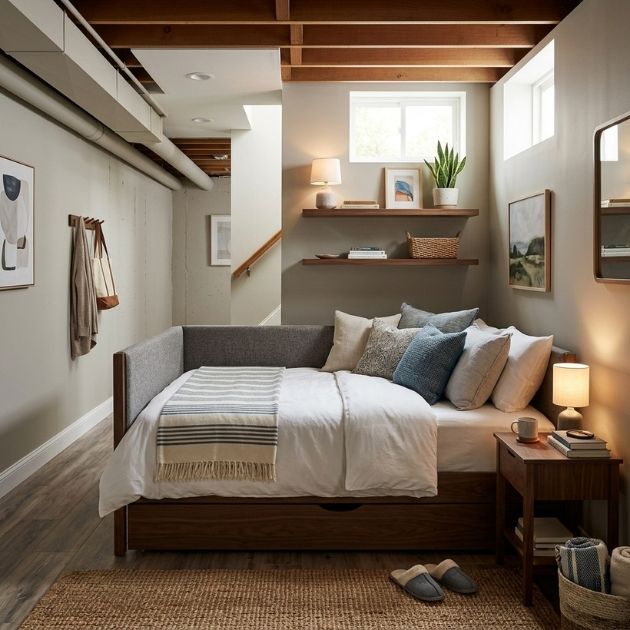
A daybed is one of the smartest pieces of furniture you can put in a narrow basement. During the day, it reads as a lounge sofa. At night, it converts to a full sleeping surface for guests. Because most daybeds sit against the wall and have a low profile, they fit naturally into tight layouts without dominating the room.
Pair a daybed with a side table, a reading lamp, and a curtain rod and sheer drape on each side to create a semi-private sleeping nook that feels intentional and cozy.
A few relevant products:
- Linen upholstered twin daybed with trundle — doubles your sleeping capacity when needed
- Sheer curtain panels on ceiling track — create privacy without a permanent wall
- Under-daybed storage drawers — make use of every inch beneath the frame
Create a Kids Corner With Low Toy Storage
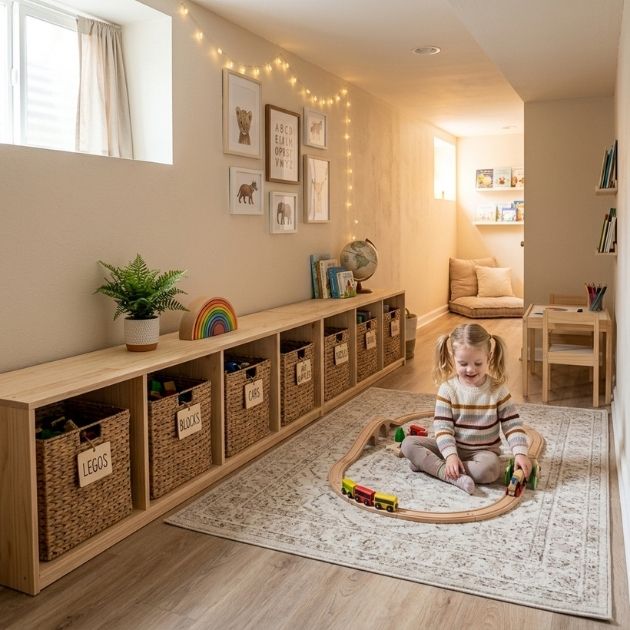
If the basement is shared between adults and kids, give children their own dedicated corner. Low, accessible toy storage, open cubbies, canvas bins, or a low bookshelf, defines the kids zone and keeps toys from migrating into the rest of the space.
Use a brightly colored area rug to signal the transition into the play corner. Foam floor tiles are another great option since they are safe, comfortable, and easy to wipe clean.
Some handy options:
- Colorful open cube organizer unit — kids can access and put away toys independently
- Washable canvas storage bins — sort toys by category and stack neatly in cubbies
- Foam interlocking play mat tiles — soft, safe, and easy to expand or remove as needed
Divide Zones With Open Shelving
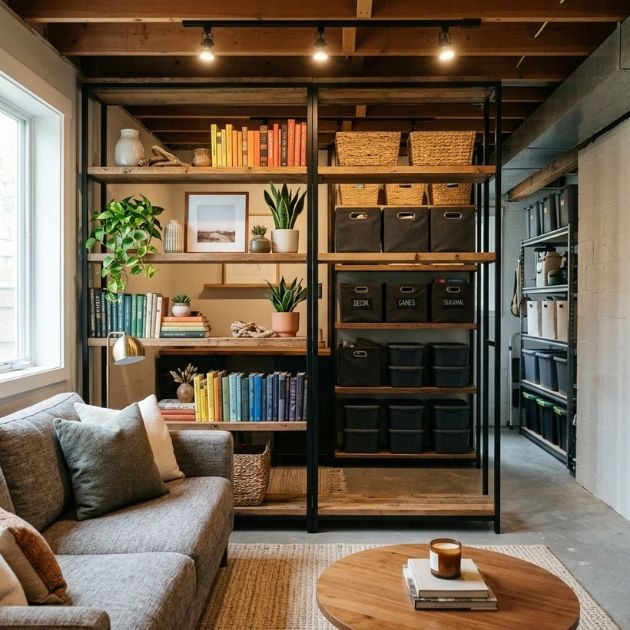
Open shelving units used as room dividers offer something solid walls simply cannot, light passes through, sightlines stay connected, and both zones feel like part of the same cohesive room. Position a bookshelf perpendicular to the long wall to mark the boundary between two activity zones without closing off the space.
For basement layouts that are especially narrow, choose shelving units that are 12 to 14 inches deep rather than standard 16-inch units. That small adjustment adds up significantly over the length of the room.
Consider these options:
- 5-tier open bookshelf in a natural wood tone — stylish divider that also stores books and decor
- Industrial metal and wood shelving unit — sturdy enough to hold heavier items
- Ladder shelf — a space-efficient option with a smaller footprint for tighter spots
Bounce Light With Mirrors in Key Spots
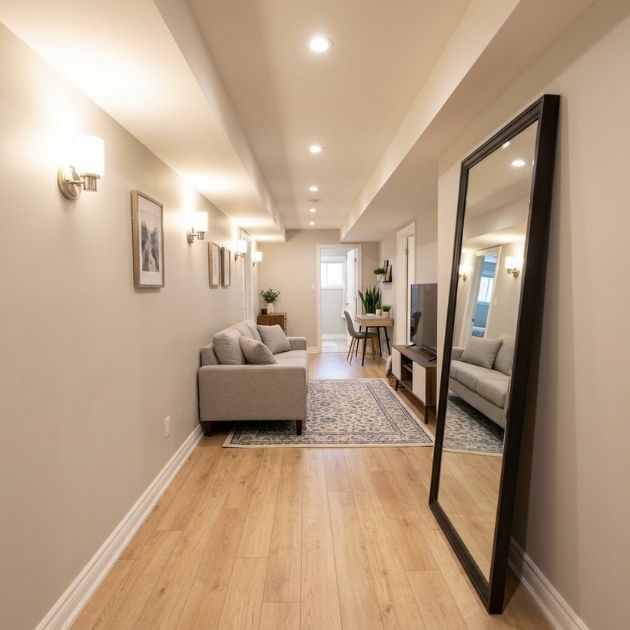
Mirrors do two jobs at once in a narrow basement: they reflect existing light and create the illusion of additional width. Hang a large vertical mirror at the far end of the basement to visually double the perceived length of the room. Place smaller mirrors along one long wall to push the perceived width outward.
Avoid mirrored walls entirely — they look dated and make the space feel like a dance studio. A few well-placed, framed mirrors achieve the same light-bouncing effect with far more elegance.
Try these:
- Large arched floor mirror (leaner style) — adds drama and light at the far end of the room
- Set of three staggered wall mirrors — modern, practical, and widely available
- Antiqued or tinted mirror — adds warmth and avoids the cold, clinical feel of clear mirrors
Shorten the Tunnel With a Dark Accent Wall
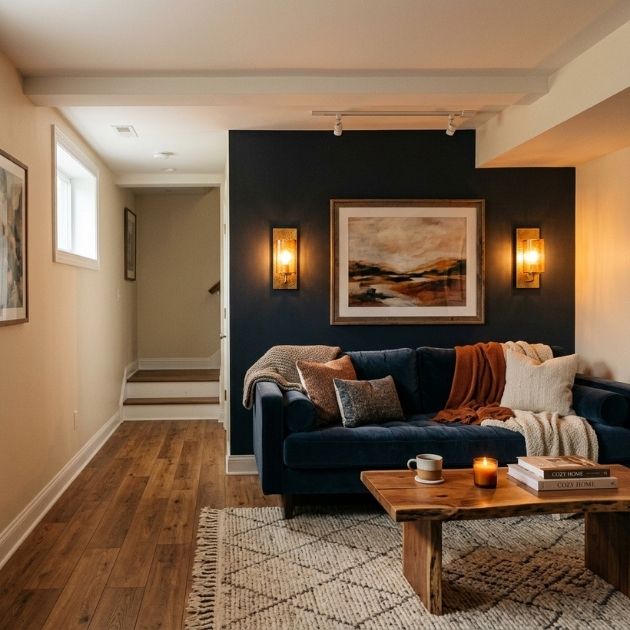
Here is a counterintuitive trick that interior designers use constantly: paint the short far wall a dark, rich color. Deep navy, forest green, charcoal, or warm espresso all work well. A dark accent wall visually pulls that end of the basement forward, shortening the perceived length of the tunnel and making the room feel more balanced.
Pair this with light walls along the two long sides of the basement to maximize the contrast effect. This approach is especially effective in basements with lower ceilings because the dark wall draws the eye horizontally rather than emphasizing ceiling height.
Products that could assist:
- Deep navy or forest green matte paint — rich, sophisticated, and surprisingly warm
- Peel-and-stick dark wallpaper — a renter-friendly alternative to permanent paint
- Floating wall shelves in a contrasting light wood tone — pop beautifully against a dark background
Swap the TV for a Projector Wall
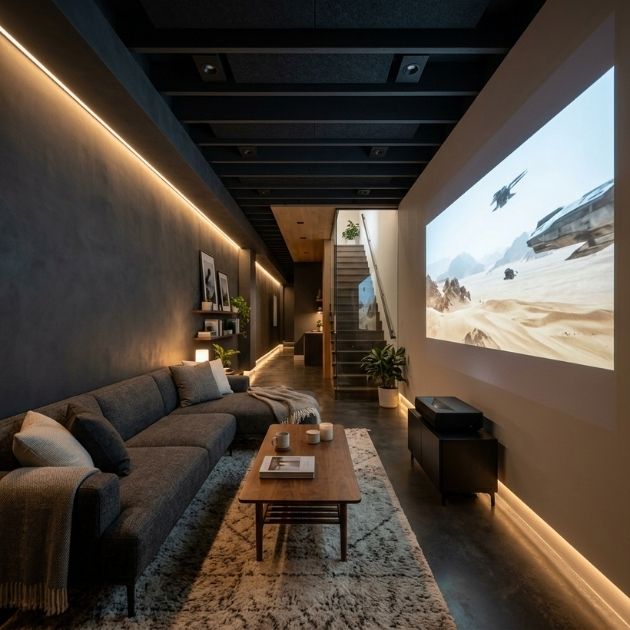
In a long narrow basement where a traditional TV and media wall feel too small for the distance, a projector and dedicated projection wall is the better choice. A 100-inch projected image fills the short end wall beautifully and creates a true home cinema experience that a screen simply cannot match.
Use light-blocking roller shades on any egress windows, and pair the projector with a Bluetooth soundbar mounted below the projection area. The result is a proper theater setup that costs less than a large-screen TV and takes up almost no floor space.
You might like:
- Short-throw LED projector — bright enough for basements without full blackout conditions
- Projector screen paint or white projector screen fabric — smoother surface than painted drywall
- Ceiling-mount projector bracket — keeps the projector out of sight and walkways clear
Final Thoughts
A long narrow basement is not a problem to solve — it is a layout to work with. The ideas above share one underlying principle: define each zone clearly, keep pathways open, and use every visual trick available to widen and balance the space.
Start with zone planning, commit to one continuous floor, anchor one end with a media wall or projector setup, and let smart storage run the length of one wall. The rest falls into place from there.
With the right furniture scale, lighting strategy, and a few clever dividers, even the narrowest basement becomes a genuinely livable, multi-functional space that your whole family will use every day.
